Carbon black is a finely divided form of shapeless carbon, that remains as soot after burning hydrocarbons. These hydrocarbons include the organic materials that we encounter as oil, coal, and natural gas. We use cement in concrete in our buildings and other structures, where it contributes 8% of global warming. Scientists at Massachusetts Institute of Technology found a way to form concrete and carbon black supercapacitors.
How Carbon Black Combines With Concrete to Create Pathways
Carbon black powder is an enduring material, despite it appearing so delicate. The authors of the Dead Sea Scrolls used it in their ink, and we can still read their writing after more than 2,000 years. About a quarter of an automobile tire contains the same black powdery material, and that can take a hammering too.
Graphite carbon is a common anode material in lithium-ion batteries, where it freely allows electrons to flow. IFL Science explains how the Massachusetts Institute of Technology used this potential to store energy in a mixture of concrete and carbon black material.
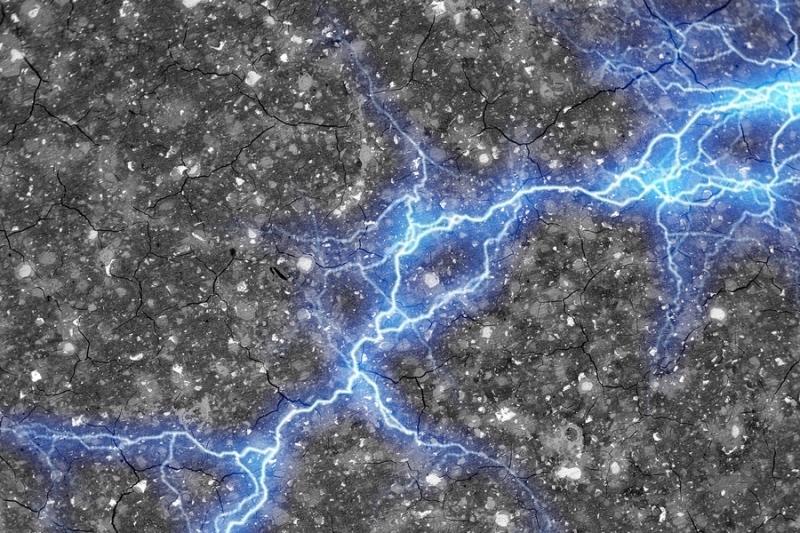
Our image illustrates how carbon black powder forms itself into a network of conductive pathways through concrete. A BBC news channel reporter visited a laboratory in Cambridge, Massachusetts, where they saw carbon black, polished concrete cylinders cause an LED bulb to flicker into life.
A Fascinating New Material for Future Energy Storage
“The material is fascinating,” a Massachusetts Institute of Technology scientist told an IFL Science reporter. You have these at least two-millennia-old materials. But when you combine them in a specific manner you come up with a conductive nanocomposite, and that’s when things get really interesting.”
This is not only a huge potential step in the global transition towards renewable energy, they continue. It also has intrinsic advantages over more traditional batteries, thanks to its recipe of abundant water, carbon black, and cement.
We doubt supercapacitors will replace batteries, because they release all their energy in a single burst. However, we can imagine a future where we store renewable energy in our highways and buildings, and cease burning fossil fuels forever.
More Information
Richer Carbon Electrodes for Faster Charging
A Supercapacitor Graphene Battery