Potassium-ion batteries traditionally use potassium in their charge-carrying cathodes, and graphite to release their energy to a device. Further research has been ongoing since these batteries emerged in 2004. A team from University of Glasgow, Scotland announced a new material for potassium-ion batteries in a press release on November 1, 2024.
Potassium-ion batteries deliver impressive storage capacity and energy. However, they have historically ceded their potential market to the lithium-ion variety, because potassium-ion battery cathodes expand during use, reducing cycling stability.
New Break Through for Affordable Potassium-Ion Chemistry
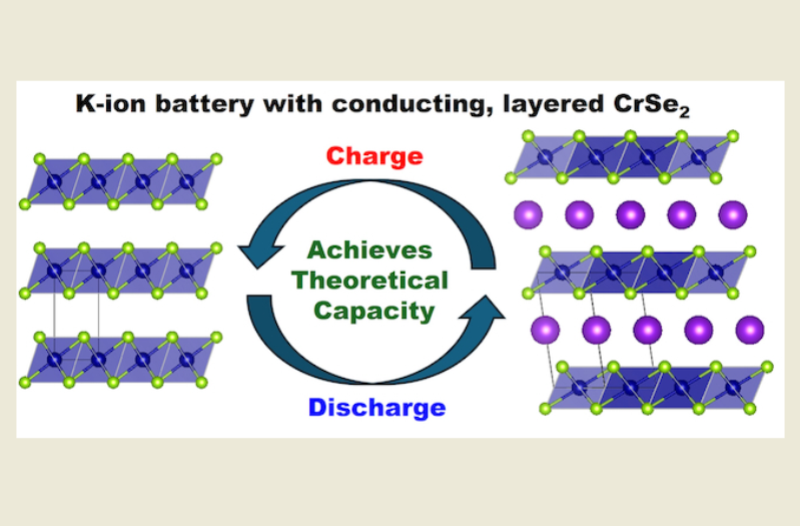
The Glasgow researchers collaborated with battery testing experts at Helmholtz Institute in Ulm, Germany, and other scientists. Their topic was a new material for potassium-ion batteries comprising layered chromium and selenium materials.
Team leader Dr Alexey Ganin explains, “Potassium is a much more abundant material, and potassium-ion batteries have a lot of potential as an alternative method of storing and delivering large amounts electricity.
“Adopting potassium-ion batteries for stationary storage purposes, could help free up lithium resources for use in more energy-intensive mobile applications in the future.” This sounds like a good deal to us.
Prussian blue has become a popular material for potassium-ion batteries, although this is not an easy material to work with. Using a naturally-conductive chromium-selenide cathode achieves high performance with less than 10% carbon.
A Positive Report After Testing the New Material
The feedback from Helmholtz Institute in Ulm, Germany is positive. The trial battery prototype has 125 milliamp-hours per gram capacity, extremely close to its theoretical maximum of 127.
The University of Glasgow, Scotland press release that we link to below, explains how “the layered nature of the material allows potassium ions to travel more easily between the layers during charge and discharge”.
This allows the battery to maintain 85% of its capacity in laboratory conditions, even when charged and discharged at high speed. “These are promising results, Dr Alexey Ganin remarks. “But we believe the performance of the battery could be boosted further with the right electrolyte.
More Information
Potassium-Ion Battery Makes Its Debut
Could Potassium-Ion Batteries Stabilize Grids