Atoms are the most basic independently existing form of matter. The name comes from the Greek word “atomos” which literally means something that cannot be split further. Atom is the smallest form of any material, which has the same properties as that material itself.
Atomic Particles
An atom is made up of protons, electrons and neutrons. Protons are positively charged particles, electrons are negatively charged and neutrons have no charge. The behavior of these particles and their mutual interactions are responsible for physical, chemical, electric, magnetic, and other properties of matter.
Periodic Table
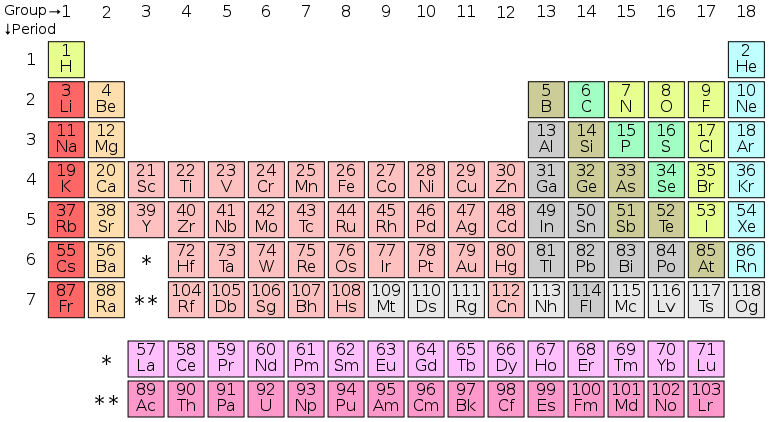
There are 98 naturally occurring elements, from atomic number 1 to 98. The number of protons in an atom is called the atomic number. Atoms from atomic number 99 to 118 have been synthesized in a laboratory. Experiments are on to produce atoms with higher atomic numbers. All 118 atoms have been arranged in a periodic table in increasing order of their atomic numbers as shown below.
Properties
Atoms do not have a fixed shape and size. Protons and neutrons are tightly joined into the atom’s nucleus. But electrons are so light that they exist as clouds, called electron clouds, and are weakly attached to the nucleus.
The number of protons and neutrons is always equal in a stable atom. The number of electrons is equal to that of protons in a neutral atom. If there are less electrons, the atom becomes positively charged and if there are more electrons, the atom becomes negatively charged.
As mentioned, electrons are very light. In fact, they are 1836 times lighter than a proton. So major contribution to an atom’s mass comes from protons and neutrons. The total number of protons and neutrons is called the mass number of the atom. The total mass of the atom is 1.66 X 10⁻²⁷ kg times the mass number.
States of Matter
Any matter can be in solid, liquid, gas or plasma state. The state of matter is determined by the density (quantity per unit volume) of the atoms in that matter. Solid will have higher density than liquid, which in turn will have higher density than gas. Plasma is made mostly of ionized atoms or ions.
It’s interesting to note that the human body is also made of atoms. The three most abundant elements in our bodies are oxygen (65%), Carbon (18%) and hydrogen (10%).
Related Articles