The International Lead Association announced exciting news on December 13, 2024, which could herald a new era for lead-acid batteries. A project, in partnership with Consortium for Battery Innovation now has a working lead-acid battery EV charging station in Missouri. The non-flammable, safer batteries there are more stable than lithium-ion, making them an attractive alternative.
The Nano-Carbon Lead Acid Batteries Behind This
The nano-carbon additive behind the lead-acid battery EV charging station for electric vehicles, improves battery performance considerably. In a nut shell, it reduces sulfation by ‘accelerating the reaction of active material’.
This refinement increases charging efficiency, delivers higher capacity retention, and high-heat long life performance. The manufacturer claims a nineteen year cycle life, when tested to the International Electrochemical Commission’s IEC 61427 standard for cells and batteries.
“This groundbreaking project has far-reaching implications for economic development and industry advancement,” remarks a member of the consortium. “By demonstrating the feasibility and benefits of electrifying fleet vehicles” with solid, reliable lead-acid technology.
We understand that the EV charging station currently draws its energy from a local grid. Although plans are afoot to add solar panels to the batteries, management systems, and power conversion systems in containers. The system appears flexible and portable, opening the door to a wide range of applications.
Why This Lead-Acid Battery EV Charging System Matters
The electric vehicle industry is dominated by lithium-ion batteries, which bring with them a statistically slight risk of explosion and fire. Incidents in apartment buildings and aboard car ferries demonstrate the implications of mass thermal runaway. Using lead-acid, and not lithium-ion batteries, reduces this cumulative risk.
And finally, there are a number of other advantages, according to the International Lead Association article. In addition to being non-flammable, the batteries are highly recyclable too.
“This is an energy storage process that can be adopted virtually anywhere, because our batteries are reliable, high-performing and cost-efficient over their lifetime,” according to the manufacturer.
More Information
Battery Fire Risks in Communal Buildings
Emerging New Risk of Lithium-Ion Batteries
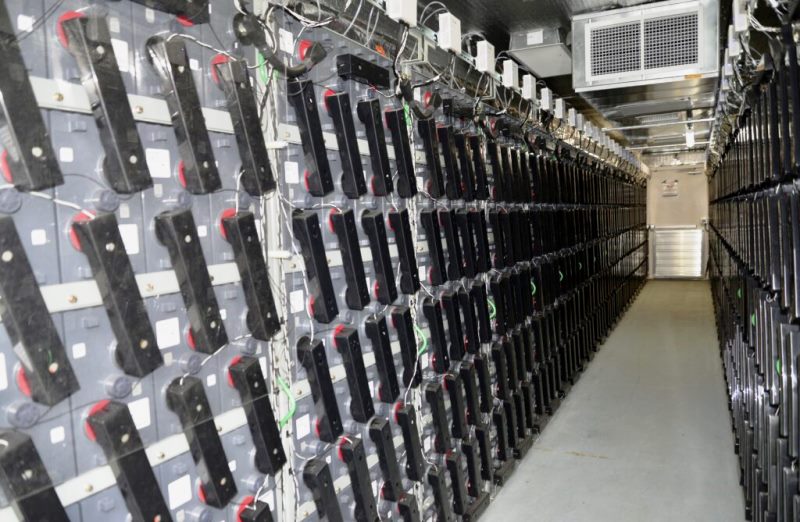
Preview Image: Lead-Acid Batteries at Alpha Site