Magnetic field measurement determines the strength and variations of the magnetic field in an object of interest. The traditional method indirectly measures the magnetic flux, using a coil of wire around a solenoid containing the material. But now researchers at University of Tsukuba in Japan have found a way to use magnetic sensing to identify battery counterfeits.
Why We Need Battery Field Magnetic Sensing Now
We append a link to the detailed research report on the Science Direct website. There, scientists observe how substandard, non-OEM battery packs in electric vehicles sometimes cause battery fires.
However, they add that current anti-fake battery technology is generally limited to barcodes, and integrated circuit chips. And these are themselves open to ‘counterfeiting through duplication or replacement’.
This work follows on increasing concern over high-density lithium-ion batteries catching fire, in electric cars and scooters. Counterfeit batteries often play a role in these incidents, making it increasingly important to spot these fakes.
There have been previous efforts to use non-destructive magnetic resonance imaging for this purpose. This complex process works, but is unfortunately impractical in the real world beyond laboratories.
Identifying Fake Batteries With Magnetic Sensors
The researchers chose pouch, prismatic lithium-ion cells for their experiment, which they sourced from different manufacturers. These may have appeared identical, but in reality their internal arrangements were distinctly different.
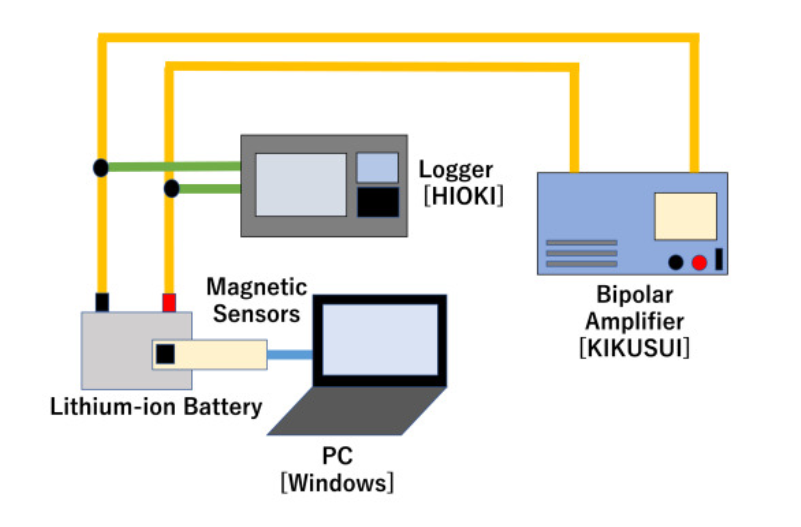
The team attached magnetic sensors to the outer surfaces of the prismatic cells, and took readings. Then they used two different approaches to determine the accuracy of magnetic sensing, to identify differences between cells:
- Theoretical models of what they expected to find.
- The data they captured under laboratory conditions.
The scientists also connected two batteries together in series, to gauge how their fields affected one another, before they announced their findings.
Their conclusions were that every battery has a unique ‘magnetic profile’. And, moreover, only two strategically positioned sensors were sufficient to determine this. This was feasible using current battery management systems they decided, making their method practical in the real world.
More Information
Battery Magnetic Field Diagnoses Li-Ion Health
Two Experiments to Plot a Magnetic Field