

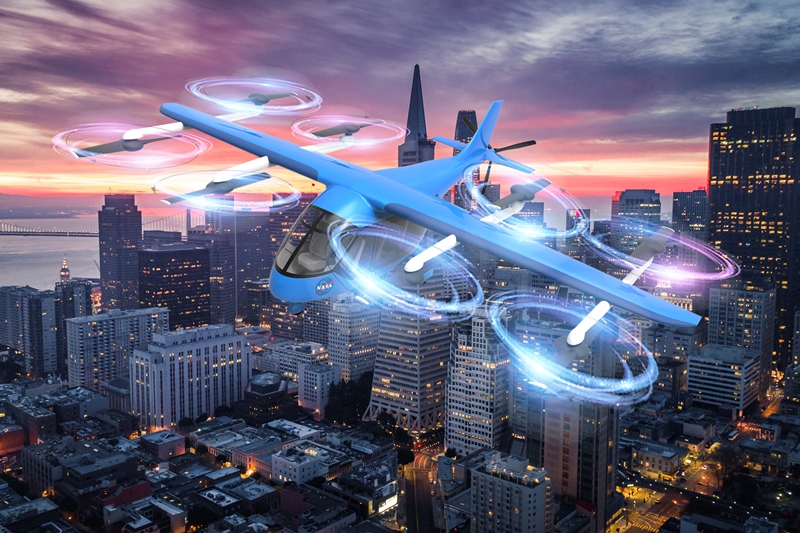
National Aeronautics and Space Administration (NASA), is investigating solid state cells as safer, more powerful batteries for aviation. They feel they can’t rely on the current range of batteries, because they believe these may break down, and even catch fire. After much research, NASA has chosen to focus on fully solid, sulfur-selenium batteries, as a likely prospect.
Sulfur-Selenium Batteries Jogs Our Memory
We scratched our heads somewhat, because that name sounded familiar. When we searched our blog, we found news of a NASA breakthrough on July 24, 2023. We scratched our heads a bit more, and remembered that sulfur-selenium batteries have the following profile:
- The cathodes comprise a blend of selenium and sulfur.
- While the anodes are made from solid lithium metal.
- The solid state electrodes are NASA’s ‘holey’ graphite.
This combination has a higher 500 watt-hours-per-kilogram density compared to lithium-ion, while being 40% lighter too, according to Wikipedia.
A Battery to Power Future Passenger Aircraft
The NASA SABERS program is an acronym for “Solid-State Architecture Batteries for Enhanced Rechargeability and Safety.” Selenium is a chemical, and an element we get from food that promotes our health.
Selenium is also used in glass making and pigments. It has occasional uses in semiconductors and photocells as well, although silicon has largely taken over. NASA decided after much thought to home in on sulfur-selenium batteries for several reasons:
- The combination stores significantly more energy than lithium-ion.
- A solid state version is cool to the touch, and does not catch fire.
- The batteries weigh less, and are slimmer than lithium-ion versions.
- They can take a beating and rough treatment, without serious damage.
Selenium is a byproduct of oil refining, and there are worldwide stockpiles. NASA is currently trialing the concept, against its five cornerstones of safety, energy density, discharge rate, package design, and scalability. We’ll report back when we have more news of further progress.
More Information
NASA Battery Power for Space Vehicles
Sulfur Selenium Battery Breakthrough at NASA
Preview Image: Concept Electric Aircraft
News Item From NASA Aeronautics
More Information


