Matters might be approaching the point where a lithium-ion fire at a battery retailer is becoming likely. Could this be one of the reasons why our lead-acid batteries remain so endearingly popular.
We guess it’s a case of ‘if you sell lithium-ion batteries you’d better be careful’. Because statistics suggest that sooner or later you could end up with a dud in your store.
Why Fret Over Lithium-Ion Batteries?
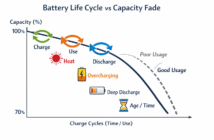
Lithium-ion batteries may develop thermal runaway, if they suffer damage or are faulty. ‘Thermal’ refers to ‘heat’, which can runaway with itself as every firefighter knows. Here is what might have caused a recent lithium-ion fire at a battery retailer:
- Thermal runaway happens when heat inside a lithium-ion battery rises faster than it can escape.
- This can be due to overcharging, manufacturing defects, physical damage, or short circuits.
- External factors could include poor cooling, or exposure to high external temperatures.
- Chemicals and flammable electrolytes begin to break down inside a lithium-ion battery, as internal heat increases.
- This creates even more heat, starting a chain reaction we know as a classic ‘thermal runaway’.
- Pressure builds inside the battery as gases form. The case may swell, emit smoke, catch fire, or even explode.
- One overheating cell can spread its heat to nearby lithium-ion batteries, causing an even larger fire.
- Thermal runaway is difficult to stop. A lithium-ion battery produces oxygen and heat once the reaction begins.
So Much For Theory. What Happened at the Retailer?
The Fire Chief at Carroll County, confirms that more than 130 firefighters and emergency crew responded to two alarms. The battery retailer stocked hazardous materials, he explained, including lithium-ion batteries.
“We did identify that we had an active fire in a pallet of batteries. We identified them as both lead-acid batteries and lithium-ion batteries. Lithium-ion batteries are the most hazardous, and we believe one of them had a condition known as thermal runaway, which is a very dangerous condition.”
More Information
Smart Sensor That Sniffs Runaway Batteries