Thermal runaway occurs in lithium-ion batteries after an internal short circuit releases high current instantly. This heat can spread to adjacent cells, resulting in a chain reaction. Materials scientists and electrical engineers created a battery thermal safety layer within a lithium-ion battery jelly roll, thereby reducing this risk.
Steady On – What Is a Battery Jelly Roll?
Most cellular battery designs comprise thin layers of several materials rolled together, and inserted in sealed tubes. These layers typically include (a) an insulating sheet, (b) anode material, (c) a separator layer, and (d) cathode material.
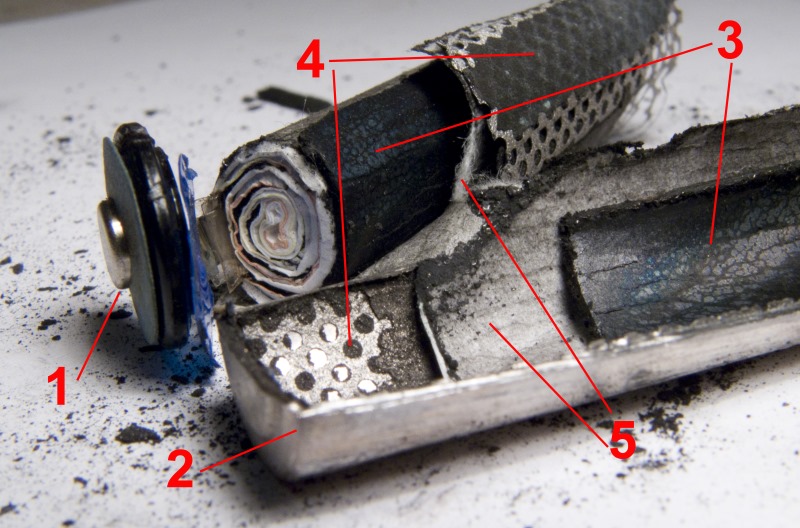
The researchers modified a basic lithium-ion jelly roll design, by inserting a battery thermal safety layer between the current collectors. They claim this ‘safety reinforced layer’ (SRL) ‘interrupts current flow during voltage drops or overheating, without adversely affecting battery performance.’
More About The Battery Thermal Safety Layer
Tech Explore explains the relevance of this piece of work, in light of the increasing number of lithium-ion battery fires. These incidents occur in laptops, phones and electric vehicles, after thermal runaway inside their batteries.
The root cause behind this, as we now know, is a short-circuit between lithium-ion battery cathodes and anodes. The LG team in Korea found a way to prevent this happening, by placing an insulating layer between these two active battery components.

This new safety shield material is a ‘molecularly engineered polythiophene with carbon additives’, according to the report we link to below.
The LG team found that adding the carbon to the SRL, ‘facilitates the doping / de-doping kinetics of the conductive polymer. While maintaining the high conductivity of SRL under standard battery operation’.
This finely-engineered battery thermal safety layer adds just 0.05% to cathode weight, while maintaining power and energy densities. Yet it halves the risk of battery explosions on impact, and so represents a significant step forward.
More Information
Thermal Gas Emissions in Lithium Batteries