The Baghdad Batteries’ remains may have vanished during a war, but their mystery persists. They first came to light near Baghdad, Iraq in 1938. And one thing seems to be sure, they were pretty ancient even then.
The Baghdad Batteries Were Over 2,000 Years Old
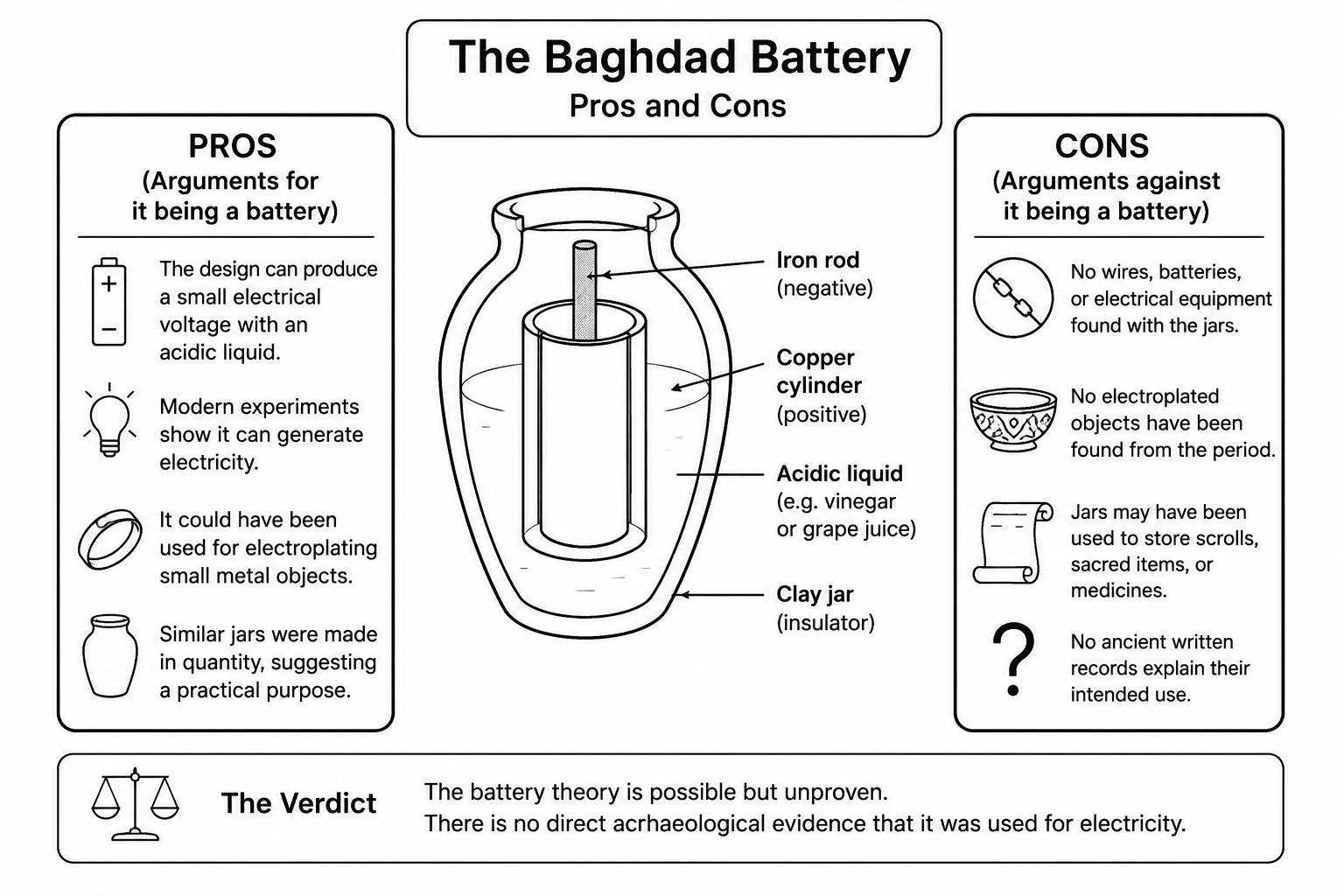
Reliable sources suggest the artifacts date back to the Parthian or Early Sassanian periods. These were between 250 BC and 250 AD, so over 2,000 years ago. There were a unknown number of these clay jars each with an iron rod in a copper cylinder.
An insulating material separated each iron and copper pair. The clay jars might have contained an acid liquid such as vinegar or grape juice. So were these artifacts batteries? Let’s see if we can discover the truth …
Were These ‘Batteries’ Actually Electrochemical Cells?
When archaeologist Wilhelm König found the remains of the ‘Baghdad Batteries’ in 1938, they reminded him of the simple electric cells we call batteries.
It’s possible that a similar arrangement could have produced a small electrical voltage. But only if the jars contained a suitable electrolyte.
Why That Possibility Remains In The Public Eye
Some researchers speculate that the ‘batteries’ might have provided power for electroplating small metal objects. Electroplating coats metal objects with another metal, by sending electric current through a chemical solution surrounding them.
Despite This, Many Archaeologists Remain Unconvinced
However, many archaeologists remain unconvinced for several reasons that challenge the battery theory:
- There is no evidence of any wires or electrical equipment near the Baghdad Batteries
- Plated items from this time and region are all gold plated and mercury gilded
- The exact end-purpose remains unknown. No written records describe anyone using the jars.
So Were The Baghdad Batteries, Batteries?
The Baghdad Batteries were in the National Museum of Iraq in Baghdad. During the widespread looting that followed the 2003 Iraq War, they vanished among many other museum treasures.
We find no objective evidence we can depend on. This fascinating case therefore remains open, from the perspective of scientific inquiry at least. Although the battery theory does seem more compelling to us.
More Information From Our Blog