Lithium-air battery capacity is theoretically exceptionally high, although not in practice right now. We share current technologies and recent efforts to achieve that goal. Once we have explained the basics, we share exciting news at the end of this short article.
The Principles of Current Lithium-Air Technology
Lithium-air chemistry draws oxygen from the air, unlike lithium-ion batteries that have both electrodes on board. This significantly reduces the battery’s size, and improves its theoretical capacity by weight.
Making The Most Of Current L-Air Battery Capacity
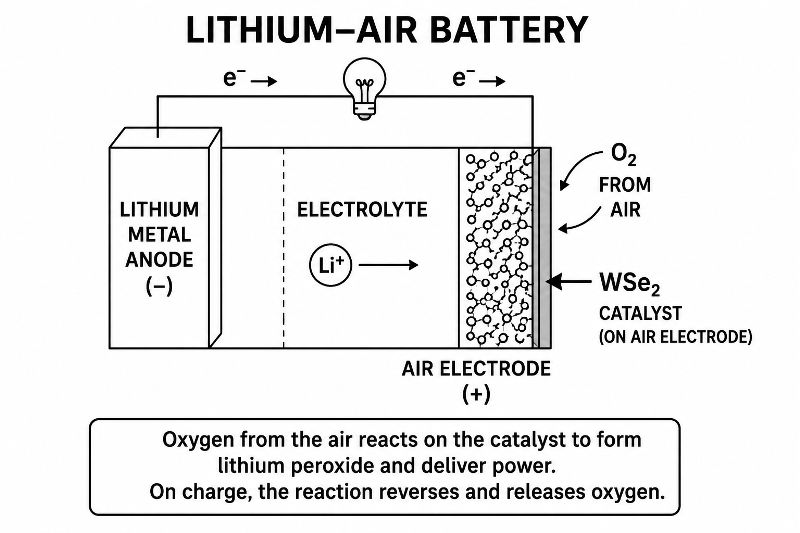
A lithium-air battery has four main components, namely a lithium metal anode, an electrolyte, a porous air cathode, and a catalyst. The chemistry of this catalyst influences the lithium-air battery’s capacity considerably.
Discharging And Recharging Lithium-Air Batteries
During Discharging
When we discharge a lithium-air battery, lithium atoms at the anode release their electrons and become lithium ions. The electrons travel through the external circuit powering the device, while the lithium ions move through the electrolyte.
Oxygen enters the porous cathode, where it combines with the lithium ions and electrons to form lithium peroxide. This compound moves inside the cathode.
During Recharging
When we recharge a lithium-air battery we reverse this process. Electrical energy breaks down the lithium peroxide, releasing oxygen and returning lithium ions to the anode. In theory, this reaction can store far more energy than today’s lithium-ion batteries.
However, several challenges prevent commercial use. The lithium peroxide that formed during discharge gradually blocks the pores of the air cathode, preventing oxygen from reaching inside of the battery. We have known for a while that a more effective catalyst could help counter this.
Research Making Lithium-Air Batteries Last Longer
A team of scientists at Korea Institute of Science and Technology have improved lithium-air battery capacity in their laboratory, with an ultra-thin, two-dimensional atomic-scale catalyst. This could bring us closer to the vision of ten-times lithium-ion capacity!
Just Imagine What That Could Do For Electric Vehicles
Electric cars could travel thousands of miles on a single charge. Renewable energy could become far, far cheaper than fossil fuels. But steady on. This was only a laboratory experiment to prove a point.
More Information From Our Blog