The advantages and disadvantages of flow batteries depend on their applications.They are not necessarily the best solution.That said, there are several aspects that do stand out.
One Major Advantage They Have Is Long Cycle Life
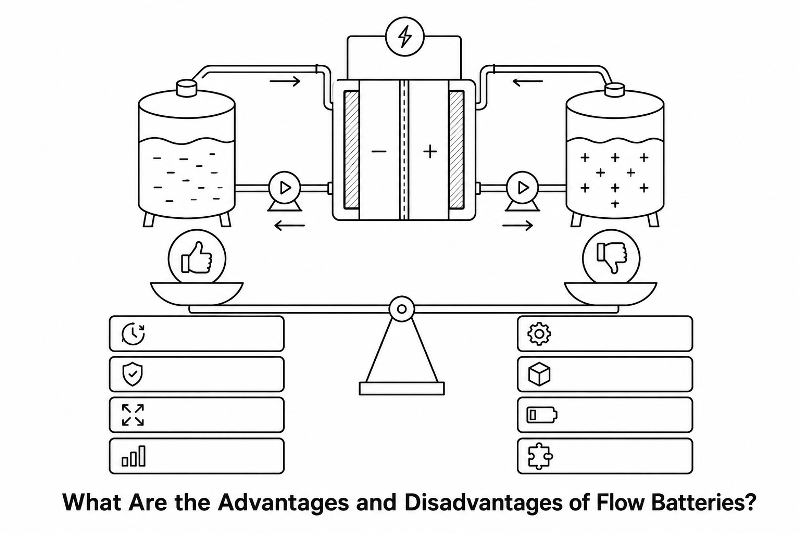
One major advantage is long cycle life. Their systems can tolerate repeated charging and discharging with relatively little degradation in some designs. This is because their energy-storage materials are in external tanks.
Flow Batteries May Also Have Good Safety Profiles.
The advantages and disadvantages of flow batteries include good safety characteristics. Many use water-based electrolytes that are difficult to ignite. However, safety still depends on the particular chemistry and system design.
Another advantage is scalability. Increasing the size of the battery cells can boost power output, while increasing the amount of electrolyte can increase energy storage. This gives designers considerable flexibility.
However, Flow Batteries Also Have Disadvantages Too
Flow batteries require a network of pumps, pipes and other equipment to move their electrolytes. These components add mechanical complexity, require maintenance, and are generally not portable.
Flow batteries can also be physically large. The tanks and associated equipment require considerably more space than a conventional battery storing the same amount of energy.
Lower Energy Density Stores Less Power Than Batteries
Another limitation is energy density. Flow batteries generally store less energy for their size and weight than lithium-ion and lead-acid batteries. This makes them incompatible where compactness and low weight are essential.
Flow batteries are also more complicated than conventional batteries because they combine electrical, chemical and mechanical components.
Flow Batteries Cannot Replace Rechargeable Batteries
So, flow batteries are not simply a better version of other rechargeable batteries. Their strengths are most apparent where long life, large-scale storage, safety, and flexible capacity matter.
These disadvantages become even more significant where space, weight, simplicity and high energy density matter most. These help explain where flow batteries are likely to make the greatest contribution.
More Information From Our Battery Blog