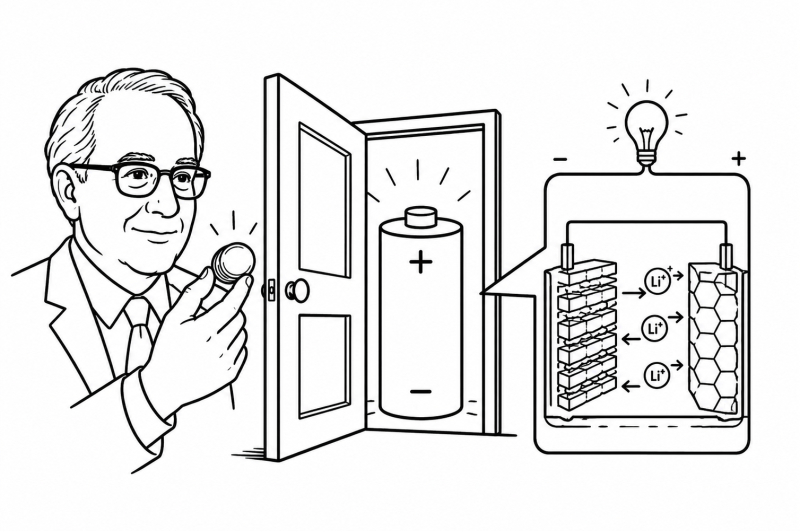
The first major lithium-ion battery breakthrough occurs, as M. Stanley Whittingham opens the lithium-ion battery door during the 1970’s. He was a young British-born chemist working for an oil company in the United States at the time.
Exxon Opens The Gate For New Technologies
Oil company Exxon was searching for new energy technologies in response to the 1977 Oil Crisis. It gave its scientists the freedom to explore ideas that had once seemed too risky or expensive.
Whittingham Stumbles Over Ion Intercalation Strategy
Whittingham realized that lithium ions could move into and out of certain layered materials without destroying their structure. This process, which we call intercalation today, is rather like sliding sheets of paper in and out of a filing cabinet. The cabinet remains intact while its contents change.
Technology Opens Doors For Lithium-Ion Chemistry
Whittingham opens a new chapter in the lithium-ion story, as he chooses titanium sulfide for his experimental battery’s positive electrode, and pairs it with lithium metal as the negative electrode.
As a battery discharges lithium ions travel through the electrolyte, while electrons flow through the external circuit, producing electricity. During recharging, the ions return to the lithium metal.
Whittingham’s choice worked surprisingly well. His battery stored far more energy than many other existing rechargeable batteries. It demonstrated that lithium ions could shuttle back and forth repeatedly. This became the foundation on which all later lithium-ion batteries would be built.
Yet One Important Problem Stood in Whittingham’s Way
Yet one important problem remained. His battery still relied on lithium metal, which could form dangerous dendrites during repeated charging. These tiny needle-like structures sometimes caused internal short circuits in Whittingham’s battery, making it unreliable and potentially hazardous.
If He Fixed That, His Battery Still Needed More Power!
The next breakthrough would come from another scientist. They believed the battery could deliver far more voltage than anyone had yet achieved. We continue with our fascinating story in the next post.
More Information From Our Blog
Waiting For Lithium-Ion Batteries – The Challenge
Whittingham Opens The Lithium-Ion Battery Door
Goodenough Increases Volts in Lithium-Ion Batteries
Akira Yoshino Makes Lithium-Ion Batteries