By the end of the 1970s, Stanley Whittingham had proved that lithium ions could move repeatedly between battery materials. His idea worked, but the battery still had limited voltage and depended on reactive lithium metal. We take up the story as John Goodenough increases volts in lithium-ion batteries.
Finding a Positive Electrode That Holds More Volts
The challenge was to find a better material for the positive electrode that could store more energy. John B. Goodenough and his research team at University of Oxford in England, accepted the challenge.
Goodenough believed that metal oxides, rather than metal sulfides, could produce a much higher battery voltage. Many scientists doubted his opinion, but his group decided to test the theory.
Testing Whether Lithium Cobalt Oxide Was The One
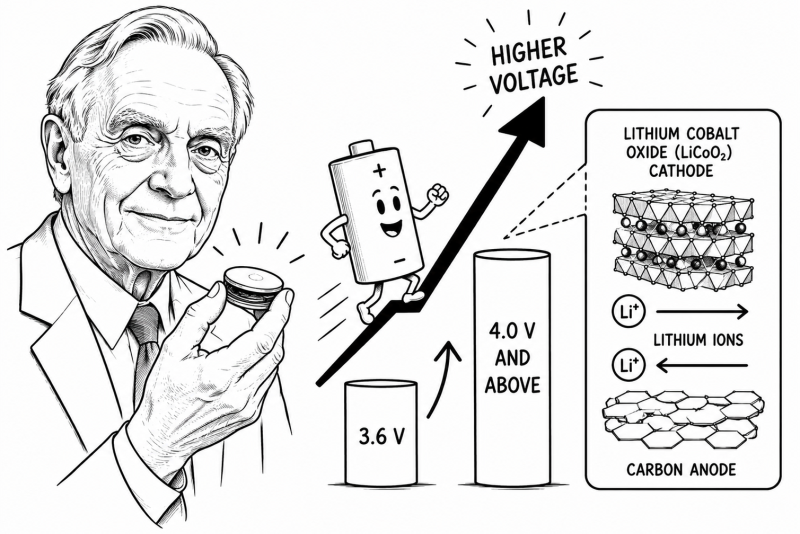
Picture the scene as Goodenough increases the volts in a lithium battery, using lithium cobalt oxide as the positive electrode. He already knew this was a layered material that could accept and release lithium ions.
His experiments confirmed that the new cathode produced about twice the voltage of Whittingham’s original design. This greatly increased the amount of energy that could be stored in the same size battery.
A Leap Forward To a More Powerful Lithium-Ion Battery
This was a remarkable advance! Higher voltage meant smaller and lighter batteries could power electronic devices for much longer. Although lithium metal was still the negative electrode, the new positive cathode made rechargeable lithium batteries far more attractive.
Goodenough Astounds Battery Scientists Worldwide
The discovery soon attracted worldwide attention. Researchers at universities and industrial laboratories began searching for ways to combine the high-energy cobalt oxide cathode, with a safer alternative to lithium metal.
Step Into The Battery Future But Not Good Enough Yet
John Goodenough’s work did not produce the finished lithium-ion battery that we know today. But it did turn what scientists believed was possible upside down. The remaining challenge was to remove lithium metal without sacrificing performance. That solution would come from Japan.
More Information From Our Blog
Waiting For Lithium-Ion Batteries – The Challenge
Whittingham Opens The Lithium-Ion Battery Door
Goodenough Increases Volts in Lithium-Ion Batteries
Akira Yoshino Makes Lithium-Ion Batteries