We wrote about natural energy systems in fish and people in our previous article. By the late 1700s, scientists knew that electricity existed, but nobody knew how to produce it. Then two Italian scientists changed history, when they built the first human battery made with their hands.
The First Human Battery Began With Two Frog Legs
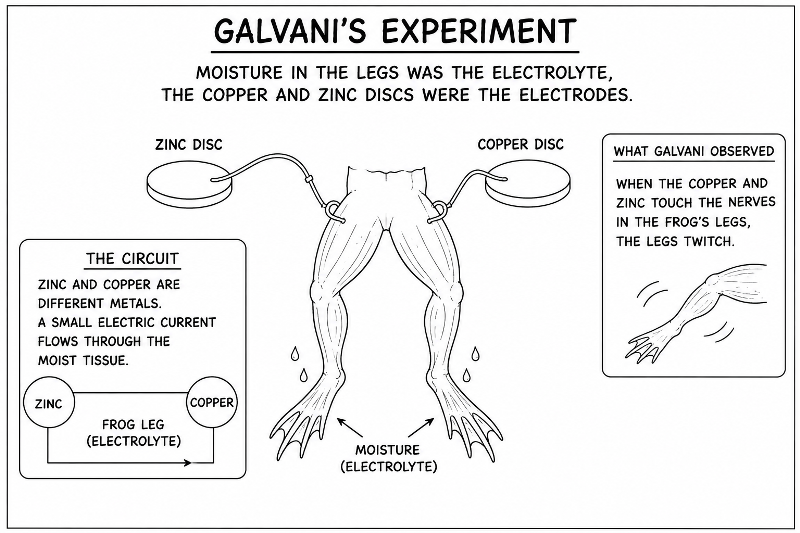
Luigi Galvani was a doctor before science existed as we know it now. He was researching animal electricity in the late 1700s when he noticed something remarkable.
If he touched two dissected frog legs with two different metals and these contacted the nerves, the legs twitched as though they were alive. Galvani believed he had discovered animal electricity flowing through the frog’s body.
But Was This Animal Electricity Or The Birth of Batteries?
But his pal Alessandro Volta was not convinced this was animal electricity. A theory is just an idea without a working example. To prove his point, Volta stacked alternating discs of copper and zinc in 1899, and separated each pair with cloth soaked in salty water.
This ‘pile’ produced a steady flow of electricity without using any animal tissue. Excited scientists began calling his invention the ‘Voltaic Pile’. It was simple, but revolutionary. Galvani’s and Volta’s names live on in the words ‘galvanic’ and ‘volts’.
A Reliable Source Of Electricity For The First Time Ever
For the first time, scientists had a reliable source of electricity they could use when ever they wished. Looking back with the wisdom of several centuries, the moisture in the legs was the electrolyte, and the copper and zinc discs were the electrodes.
However , Volta’s First Human Battery Did Not Last Long
The first human battery by Volta did not last long, and it was not very powerful. Even so, it opened the door to countless discoveries. Researchers could now perform experiments that had previously been impossible.
Volta’s Battery Marked The Beginning Of The Electrical Age
Galvani’s and Volta’s work gave batteries a great start. In the next article in this series, we meet the scientist who discovered how to generate electricity continuously. This made modern power stations possible.
More Information From Our Battery Blog