A battery may look quite peaceful from the outside, while inside it is a hive of activity. Whether we switch on a torch, start a car, or use our mobile phone, the battery starts converting chemical energy to electrical energy. This is what happens inside a battery in headline terms.
Charged Particles Called Ions Move Inside The Battery
We find two electrodes separated by an electrolyte inside every battery. The electrolyte allows tiny charged particles called ions to move between these electrodes. That, in a nutshell, is what happens inside every battery each time it discharges.
However, the electrons taking the electricity to an external circuit cannot travel through that electrolyte. And so, instead, they flow through an outside connection via the battery terminals, before returning to the battery. Both the ions and the electrons are essential to keep the battery working.
What Happens Next? The Ions And Electrons Keep Moving
The ions and electrons must keep moving, if we want to continue powering our device. More and more ions move from one electrode to the other, as the battery delivers electricity.
Eventually, fewer and fewer ions are available to continue the chemical reaction. Finally, the battery can no longer supply enough electrical energy. The battery is discharged, or ‘flat’ like a balloon that lost its air.
But The Battery Is Not Actually Empty Like That!
The battery is not really empty. Most of its materials are still there inside the case, but the chemicals have reached a point where they can no longer produce a useful flow of electricity. In other words, they need a recharge if their design allows that.
How Discharging a Flat Battery Happens Gradually
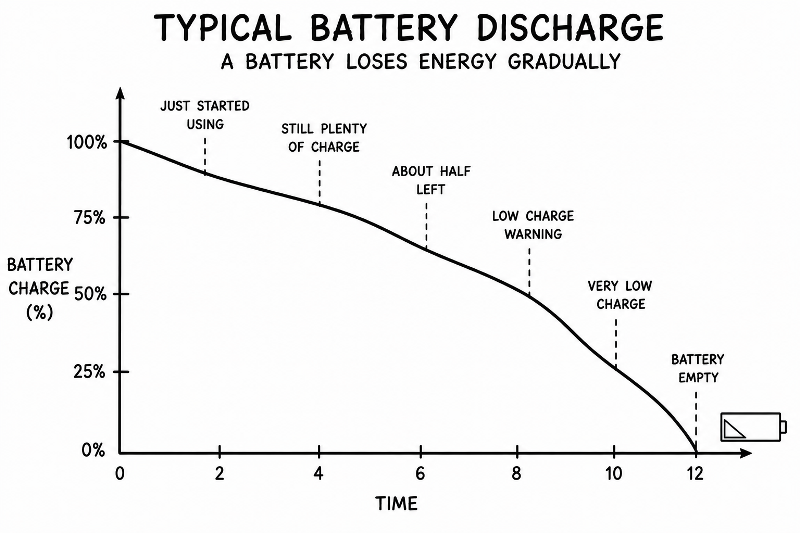
Discharging a battery happens slowly. That is why your phone battery shows its charge reducing gradually, instead of stopping all at once.
Every rechargeable battery works in much the same way, whether it is lead-acid, lithium-ion, or sodium-ion. The materials may differ, but the basic process is remarkably similar.
Our Next Article Describes How We Reverse Discharging
We describe how a battery charger reverses these chemical reactions, if the battery allows it, and prepares the battery to work again, in our next article.
Ore Information From Our Battery Blog