Not every rechargeable battery uses lithium ions. In fact, there’s a new contender, the sodium-ion battery, that would like to push them off their perch with sodium ions. But, where do those sodium ions come from in the first place?
Sodium is a chemical element that’s abundant throughout nature. It is present in rocks, minerals and dissolved salts. Even ordinary table salt contains sodium combined with chlorine.
Like Lithium, Sodium Atoms Can Also Lose Electrons
When a sodium atom loses one electron due to an external force, it becomes a positively charged sodium ion, we spell ‘Na’. This ion is able move through the electrolyte inside a rechargeable sodium-ion battery. That answers one question, ‘where do those sodium ions come from‘. But it raises another one.
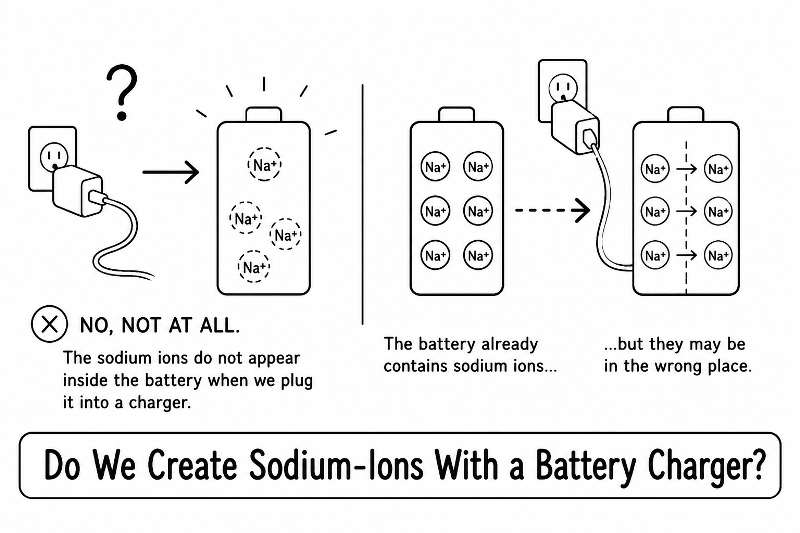
Do We Create Sodium-Ions With a Battery Charger?
No, not at all. The sodium ions do not appear inside the battery when we plug it into a charger. The battery already contains sodium ions, but they may be in the wrong place.
Charging Makes Sodium Ions Move Between Electrodes
Charging makes sodium ions move between the battery’s two electrodes. However, when the battery supplies the electricity, the ions move back in the opposite direction.
Meanwhile, electrons travel through the external electrical circuit. This flow of electrons is the electric current that operates an external device. Lithium-ion batteries follow the same principle: ions move inside the battery while electrons move through an external circuit.
Could Sodium-Ion Batteries Compete With Lithium-Ion?
In theory, sodium-ion could not, because lithium-ion is more powerful. However. sodium attracts attention because it is more widely available and cheaper.
But sodium ions are larger than lithium ions, so battery manufacturers need different electrode materials and must design the chemistry carefully.
The Decisive Reason: Why To Consider Sodium-Ion
The important point is that the sodium ions have a natural origin.They come from sodium-containing materials made from Earth’s abundant resources.
More Information From Our Battery Blog