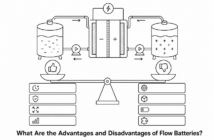
A flow battery produces electricity as its liquid electrolytes pump through its battery cell. This process starts in the two storage tanks. Each tank contains an electrolyte, mostly with different chemical properties. When electricity is required, pumps move the liquids from the tanks towards the cell.

The Two Electrolytes Enter Separate Sides Of The Cell
The two electrolytes enter separate sides of the cell. A special membrane keeps them apart while allowing certain ions to pass through.
Meanwhile, chemical reactions take place at two electrodes Inside the cell. These reactions cause electrons to be released on one side and consumed on the other.
The Electrons Cannot Pass Through The Battery Membrane
The electrons cannot pass through the membrane in the same way as the ions do. Instead, they travel through an external electrical circuit as the flow battery produces electricity. That flow of electrons is the electrical current produced by the battery.
Ions Flow Through Battery Membrane Maintaining Balance
At the same time, ions move through the membrane to maintain the chemical balance between the two sides. The electrolyte continues flowing through the cell as these reactions take place.
The liquids then leave the cell and return to their storage tanks. They continue circulating while the battery is producing electricity.
When The Stored Chemical Energy In The Battery Is Used Up
When the stored chemical energy is depleted, we can recharge the battery . An external electrical supply then reverses the chemical reactions, and restores the electrolytes to their energy-rich state.
This Is The Key Idea Behind Every Flow Battery
This is the key idea behind every flow battery: The electrolytes carry the chemical energy, while the battery cell serves as the place where that energy converts into electricity.
Because the electrolytes are stored outside the cell, a flow battery can use very large tanks. This makes this technology particularly interesting for storing electricity from sources such as solar and wind power.
More Information From Our Battery Blog