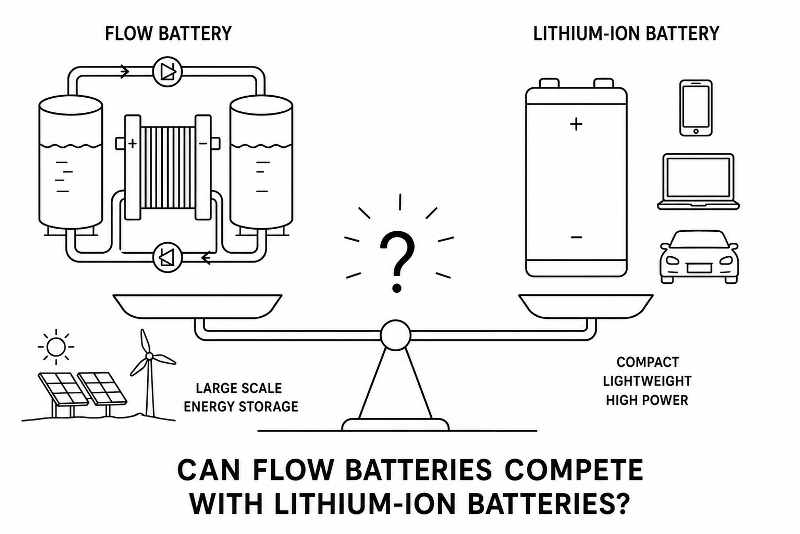
Can flow batteries compete with lithium-ion batteries? Both of them store electricity, but manufacturers produce them to solve different problems. The question is therefore, not simply which technology is better.
Lithium-Ion Batteries Enjoy Several Important Advantages
Lithium-ion batteries have several important advantages. They are compact, lightweight, and able to deliver high levels of power. These qualities make them particularly useful in mobile phones, laptops, electric vehicles, and many short-duration energy storage systems.
Flow Batteries By Comparison Take a Different Approach
Flow batteries, on the other hand, take a different approach. Their energy resides in liquid electrolytes in external tanks. The battery cells produce the electrical power, while the tanks determine how much energy can be stored.
This separation of functions can make flow batteries attractive for large, stationary installations. If more energy storage becomes necessary, larger electrolyte tanks may be added without necessarily increasing the size of the battery’s power-producing components.
Flow Batteries Also Have a Longer Operational Life
Flow batteries may also have a long operational life. They can charge and discharge repeatedly, with relatively limited degradation of the electrolyte. Some chemistries also offer further advantages in areas including fire safety. But does this mean flow batteries can compete with lithium-ion?
However, Flow Batteries Do Have Their Disadvantages Too
However, flow batteries have their disadvantages too. They are generally larger and more complex than lithium-ion batteries. Pumps, tanks, pipes, and other equipment circulate the electrolytes. Set up costs can also be significant.
Flow Batteries Cannot Replace All Lithium-Ion Batteries
Flow batteries are highly unlikely to replace lithium-ion batteries. Instead, the two technologies may increasingly serve different parts of the energy storage market.
Lithium-ion batteries remain strong where space and weight matter. Flow batteries may become increasingly important, where we require long-duration, large-scale stationary energy storage. They may keep working for as long as 20 years.
More Information From Our Battery Blog