Inventors needed better sources of electricity as the nineteenth century progressed. The porous pot cell made a practical contribution that met a very real need. Scientific experiments were increasing…
The electric telegraph was creating a need for dependable batteries that could operate for long periods. Large bulky batteries were becoming a nuisance!
Daniell’s Cell Was Stable But Occupied Too Much Space
John Frederic Daniell’s battery had already solved a major problem.. Earlier voltaic batteries lost power as hydrogen accumulated on one of their electrodes. The Daniell cell provided a more stable current, but its design could still be improved.
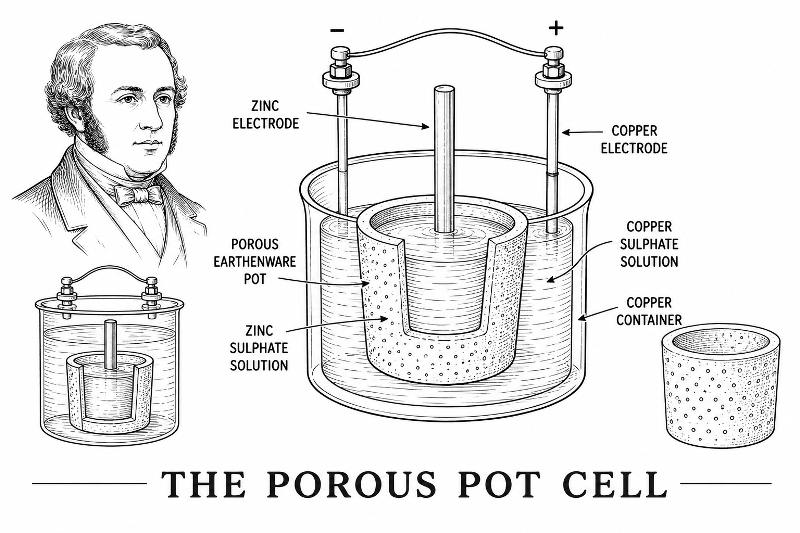
The next important step came from John Dancer, a Liverpool instrument maker with an interest in scientific equipment. In the late 1830s, Dancer developed the porous pot cell, a compact version of the Daniell design.
Dancer’s Innovation Centered On a Simple Earthenware Pot.
The porous pot cell made a practical step forward, centered on a simple clay pot. The zinc electrode and its electrolyte were inside the un-glazed porous container. This pot was inside a copper vessel containing a copper sulfate solution.
The tiny pores in the earthenware allowed ions to pass between the two chemical environments, while delaying the direct mixing of the solutions. This helped the battery continue producing electricity more effectively.
This Design Contained The Cell In a Single, Practical Unit
The design made it possible to place the components inside a single, practical structure. This was an important advantage, as batteries began moving from laboratory experiments towards real-world applications.
The porous pot cell became particularly useful during the expansion of telegraph systems. Networks needed dependable sources of electricity, and continuously over longer periods. A battery that could provide a relatively steady current was far more useful than earlier cells that soon weakened.
Dancer Proved Progress Often Depends On Engineering
John Dancer’s contribution demonstrated that battery progress often depends on practical engineering, as much as new chemistry. He did not need to invent an entirely new battery. Instead, he improved an existing idea by finding a better way to engineer its chemical components.
The Porous Separator Became An Important Element
The porous separator became an important element in battery design. Variations on this theme remain fundamental to electrochemical cell design today.
More Information From Our Battery Blog