Electricity was becoming increasingly important for communication by the 1860s. Telegraph networks were spreading across Britain, America and other countries. Then Callaud came up with an unusual idea. Why not let gravity cell chemistry manage the separation?
Telegraphy Needed Large Numbers Of Cheap Batteries
Telegraph operators needed large numbers of batteries capable of delivering dependable current without being unnecessarily complicated or expensive.
The Daniell cell and its porous pot version, provided reliable electricity. However, the porous barrier added cost, and created resistance inside the battery. Inventors continued searching for simpler designs.
A French Inventor Asked Why Not Use Gravity Instead?
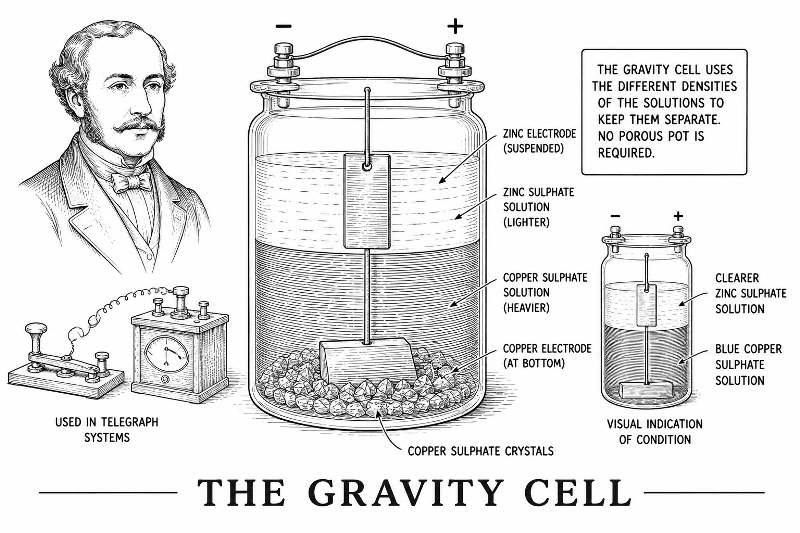
A French inventor Monsieur Callaud developed an elegant solution during the 1860s. He invented a gravity cell without a porous separator. Instead, the battery relied on gravity and the different densities of its chemical solutions.
A layer of zinc sulfate rested on top of a layer of copper sulfate. Their different densities kept the two liquids separate. A layer of oil on top of the two prevented evaporation. This design let the gravity cell chemistry manage the separation.
So Far For The Chemistry, But What About An Electrode?
A copper electrode rested at the bottom of a glass jar, surrounded by copper sulfate crystals and solution. A zinc electrode was suspended near the top.
Zinc sulfate formed around the upper zinc electrode as the battery operated. The battery could function without a porous pot, because the solutions remained in separate layers.
Removing The Barrier Reduced Internal Resistance
Removing the barrier reduced internal resistance and allowed the cell to deliver a stronger current. It also made the design simpler, although the battery had to remain upright so that its chemical layers remained separate.
The Gravity Cell Worked Well In Stationary Applications
The gravity cell became particularly well suited for stationary applications. It quickly found an important role in telegraph systems, provided batteries could be kept in one place and regularly maintained.
More Information From Our Battery Blog
Monsieur Callaud And His Gravity Battery
Callaud’s Gravity Cell Eliminates Porous Barrier