

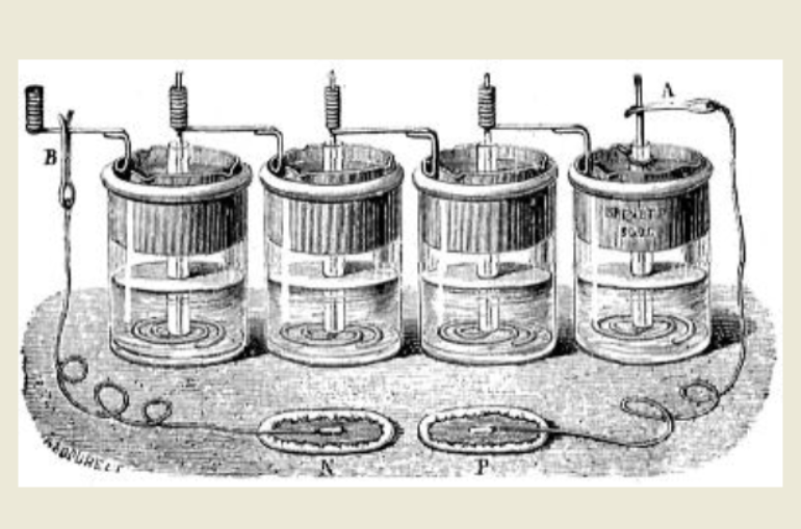
We always acknowledge the human minds who steered the birth of batteries. However, this time our research skills failed us, and we were unable to discover who the mysterious Monsieur Callaud was. All we know is he invented the gravity battery, and this became an industry standard well into the 1950’s. However, we are not alone, because nobody else seems to know who Monsieur Callaud was either. He vanished from the page of history.
How the Gravity Battery Outperformed Daniell’s Cell
Daniell’s porous earthenware barrier increased internal resistance, and hence the performance of his battery. Bird and Dancer tinkered with the original design, but never found a way to get around that limitation. Monsieur Callaud, on the other hand tackled it head on, and made a significant improvement to early battery design.
He did away with the porous barrier, eliminating that source of internal resistance. His modified version also delivered a stronger current. And as a result soon it became the battery of choice for American, and British telegraph networks. But how did Callaud achieve this?

- First, Callaud arranged a glass jar with a copper cathode on the bottom.
- And then he suspended a zinc anode beneath the rim of his apparatus.
- Next, he scattered copper sulfate crystals around the copper cathode.
- And finally, Callaud filled the glass jar to the brim with distilled water.
History does not recall what inspired the Frenchman to come up with this unique arrangement. However, the results were groundbreaking.
What the Gravity Battery Did, and Achieved
A clear zinc sulfate layer formed at the top of the jar around the zinc anode as current was drawn. However, this remained separate from the deep copper sulfate layer at the bottom of the jar, because of lower density and cell polarity. A skilled technician could estimate the battery life at a glance simply by glancing at this.
Monsieur Callaud’s invention took batteries to the next stage in their evolution. However, it was not perfect by any means. The battery needed to be stationery to avoid the layers mixing or spilling. And it had to operate continuously to prevent the solutions mixing by diffusion. The search would continue.
More Information
Daniell Cell Solves Hydrogen Bubble Problem


