James Prescott Joule, born 1818 was an English brewer of beer with a scientific bent. He was interested in knowing how much ‘work’ he could extract from a given source, in other words the ‘convertibility of energy’. This required a single unit of measurement the International System of Units later called a Joule.
For our purposes, a Joule is ‘the work required to produce one watt of power for one second. However nowadays with electricity everywhere but at a cost, we focus on the rate of energy consumption over time in terms of watts.
The Measure of Energy Consumption Over Time
We call this ratio Power, where [power = energy over time]expressed as [1 watt = 1 joule / second]. Let’s say, for example we have a 75 Watt light bulb that produces 75 joules of light every second from 75 joules of electricity.
If we left it on for 30 minutes (1,800 seconds), we can calculate the energy consumed as follows:
- We use the basic principle [energy = power x time]
- The formula is [(75 watts / second) x 1,800 seconds]
- Thus the overall energy consumption is 135,000 joules
Due the large numbers this calculation produces, watts have become a more convenient way of expressing James Prescott Joule’s idea. So we use watts to relate energy to work produced. This helps us compare for example the energy consumption of a 1,000-watt microwave with a 2,000-watt one.
Calculating the Energy Required for Our Home
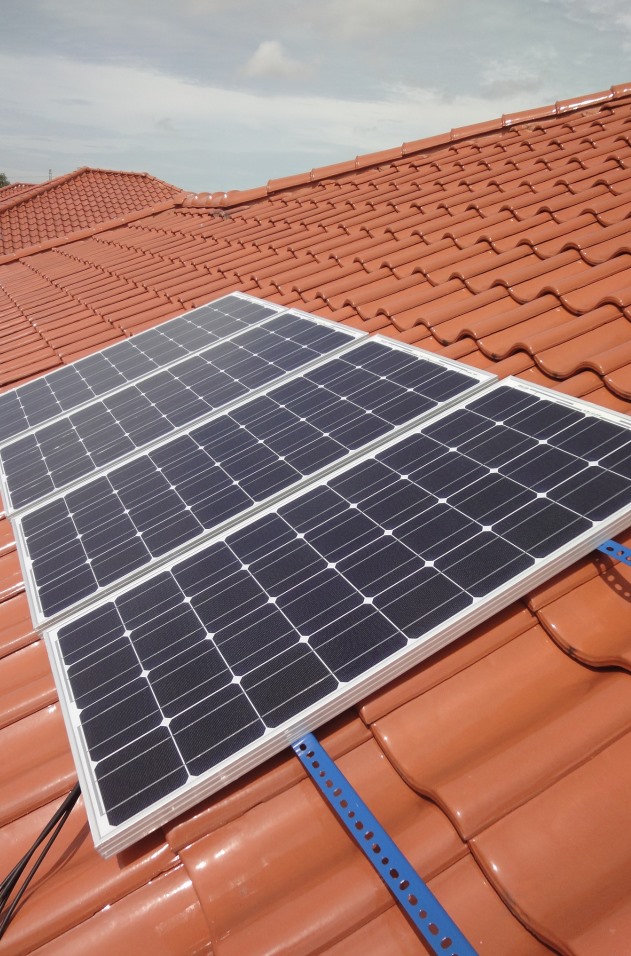
Joules are not an ideal measure of Energy consumption because they produce such large numbers. Thus nowadays we prefer using kilowatt-hours instead. One kilowatt-hour = a thousand watts consumed for 60 minutes. This delivers a more manageable number, especially if we are entering it on a spreadsheet.
An average U.S. home uses 14.2 kilowatt-hours of energy on average daily, although this does include energy wastage. This is after we smooth out seasonal differences too.
Let’s assume we have five hours of sunshine every day. We can use this information to calculate the square meters of Solar Panels we require.
This will be the subject of the next post in our measure of energy series. It deserves its own space and dedicated attention.
Related
The Difference Between Energy and Power
Defining Amps, Watts, Volts and Ohms
Preview Image: Thunderstorm near Pritzerbe (Germany)