The barocaloric effect is a thermal response in a material to compression. As heat is a form of energy, this is of interest to battery scientists. Our first reaction was to imagine this phenomenon in a liquid or gas. However, when we visited Science Advances we discovered the barocaloric effect in thermal batteries applies to certain plastic crystals too.
Using Barocaloric Plastic Crystals in Thermal Batteries
Researchers investigating alternative refrigeration discovered a massively-pressure-sensitive group of disordered solids called plastic crystals (see reference below). They probed this phenomenon, as a first step to next-generation solid-state refrigeration technologies.
But meanwhile another group of scientists have taken this a step further (see second reference below). This was after they perceived a potential way to harvest and reuse low-temperature waste heat using ammonium thiocyanate (NH4SCN).
Now ammonium thiocyanate, as we discovered when we skimmed through their report, has a large inverse barocaloric effect. In fact, the output at depressurization is 11 times greater than the input mechanical energy required. Moreover, the compression is stable, promising long-duration storage.
Future Potential of Such Thermal Batteries
The second group of researchers sees potential for harnessing the barocaloric effect in thermal batteries. They say “the production of heat accounts for more than 50% of global final energy consumption”. While “72% of the global primary energy consumption is lost after conversion, mainly in the form of heat”.
Now, if we factor in the fact that “among the waste heat spectrum, 63% is below 100°C,” we glimpse the potential. Especially to store low-temperature waste heat, and reuse it directly for heating purposes. The researchers propose thermally charging their active material under pressure. And then releasing the pressure to harvest that warmth.
More Information
Anode and Cathode Making a Perfect Pair
Vacuum Tube Batteries in Bygone Times
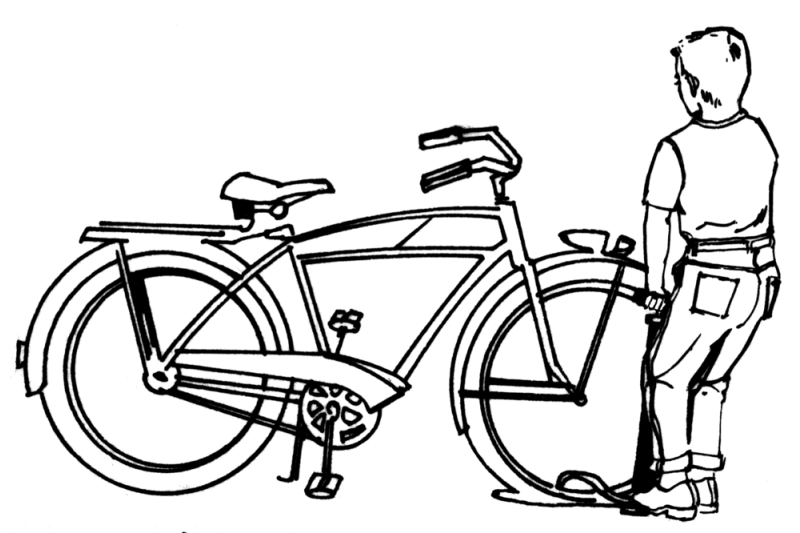
Preview Image: Pumping a Bicycle Tire
References