AB-303 is a piece of draft legislation now before the California Legislature for consideration. The proposal surfaced a week after the fire at the Moss Landing Power Plant in Monterey County. If approved, California’s AB-303 ‘Battery Energy Safety & Accountability Act’ will impact future BESS battery storage projects throughout the State.
The Broad Remit of California’s AB-303 Proposal
The intent of the Bill is to “improve safety standards and restore local oversight for BESS facilities in California.” One of its main thrusts will be to limit approval authority to local government agencies, according to Market Screener. While also requiring local input, and distance from environmentally sensitive sites too.
The following are highlights from California’s AB-303, as currently before the California Legislature:
- The Bill only applies to BESS systems with 200 megawatt-hour capacity or greater.
- It restricts the siting of future BESS storage facilities, including proximity too ‘environmentally sensitive’ sites.
- The Bill furthermore forbids future BESS locations within 3,200 feet of ‘sensitive receptors’.
- It prevents developers of future BESS projects from applying to the California Energy Commission (CEC).
- And finally, the Bill requires the CEC to deny all applicable pending BESS projects in the pipeline.
Where Are These ‘Sensitive Receptor’ Sites?
Once again, the parameters of the proposal are broad, and we would have to see how the administrators interpret them:
- Various coastal zone areas as defined under the California Coastal Act.
- Prime farmland or farmland of statewide importance under other legislation.
- Land zoned or designated for agricultural protection or preservation by a local ballot.
- Wetlands, land in very high fire hazard severity zones, and hazardous waste sites.
- Land within delineated earthquake fault zones, special flood hazard areas, or regulatory flood ways.
- Land identified for conservation in adopted natural community conservation plans.
- Habitat for protected species identified as candidate, sensitive, or species of special status.
- Habitat for protected species, or species protected by Federal or State legislation, or under conservation easement.
And finally, ‘sensitive receptors’ include residences, educational resources, community resources, health care facilities, live-in housing, and businesses open to the public.
More Information
BESS Systems Take on Thermal Runaway
Moss Landing Battery Fire Demands Answers
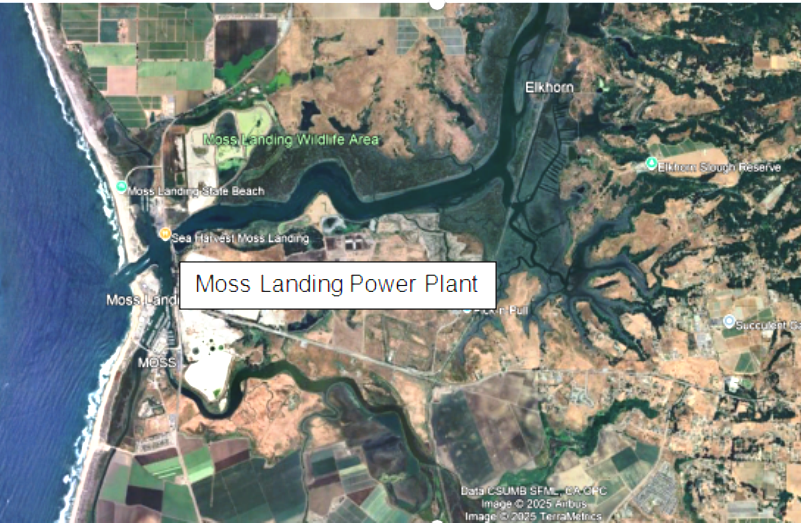
Preview Image: Moss Landing Power Plant from Google Earth