Evaporation occurs when the surface of a liquid transforms into a gaseous phase. Removal of energy leads to slight cooling of the liquid. The process will continue until the rate of evaporation equals the rate of re-condensation. Let’s understand how climate change upsets the balance and leads to fast evaporation.
How Fast Evaporation Affects the Natural Water Cycle
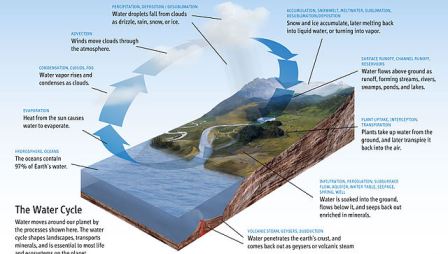
Evaporation is an essential component of earth’s water cycle. Solar energy warms water in rivers, lakes, and oceans, and moisture in the soil. When these sources are open to the elements, molecules escape to form water vapor. This vapor is lighter than air and rises to form clouds.
Surface water may disappear completely if the soil is drying out, or a dam is close to empty. It falls back to earth again when sufficiently heavy to succumb to gravity. However, clouds of water vapor may travel long distances before this happens. Then the moisture in the atmosphere returns to a different place from where it came.
How Global Warming is Disturbing this Water Cycle
Global warming is shifting global rainfall patterns. North America is becoming wetter as the tropics become drier. Antarctica is now the driest place on earth in terms of rain.
Global warming is accelerating this redistribution of water. Higher air temperature translates into warmer water on the earth. Faster evaporation occurs due to greater kinetic energy on the surface. Trees and plants that once shaded soil begin to wither as chronic deforestation kicks in.
Humankind is in serious trouble, particularly in cities like Moscow and Beijing which are far from the ocean. New York and London are more robust because of opportunities for desalination.
Cape Town taught us how important it is to plan, predict and take proactive action ahead of fast evaporation of dwindling resources. Mass desalination is still in its infancy. A new water structure for a large city could take a decade to establish. We call for action.
Related
Outcomes of Climate Change: Severe Drought
Fresh Water Out of Salt Water Experiment
Preview Image: Diagram of the Water Cycle
Video Share Link: https://youtu.be/jMTG7rcrffc