Before we connect you to the video, you are going to need a nine-volt dc battery, a plastic cup, two disc magnets, a pair of paper clips, and a length of insulated copper wire. The other odds and sods like cardboard, glue and scissors are lying around the house. Before we start, let’s first understand the basics of how a dc motor works.
Basic Working Principles of a DC Motor

An electric motor makes use of magnets to create motion. Pick up the two disc magnets and place them together.
The result depends on whether the touching poles are different (negative / positive) or the same (negative / negative OR positive / positive).
In the first instance, the batteries will click together. In the second, they will jump apart. We just turned magnetism into motion!
How This Works in a DC Motor in Practice
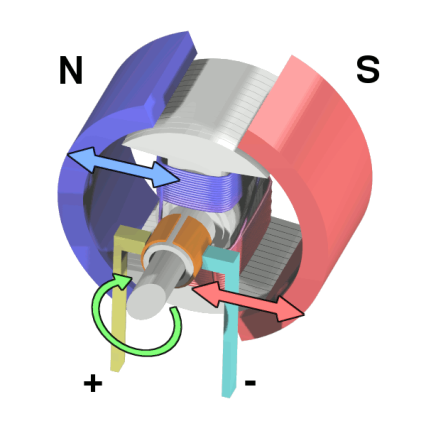
In a dc motor, the armature or rotor in the middle is an electromagnet we energize by applying an external power source. With small motors, the magnetic state of the field around it is permanent. In big motors though, the field magnet also gets its energy from the external power source.
By applying power to the armature, we cause the motor to spin in an ‘attempt to escape’ from the fields trying to push it away.
The direction it turns depends on which way round we connect the external power source. That’s all there is in theory, although in practice there is more to it of course. Here’s the video we promised so you can make your first dc motor
Where to Find a DC Motor Near You
The earliest electric motors were direct current versions, because they did not need transformers and fed directly off dc electricity distribution systems. We find them everywhere we go in tools, toys, elevators, escalators, electric cars, and even steel rolling mills. The principles are the same. The practical details depend on the size of the dc motor.
Related