Aqueous rechargeable zinc-ion batteries use stable, water-based electrolyte. This makes these secondary batteries safer, and more environmentally acceptable than their volatile lithium-ion contemporaries. However, zinc-ion batteries are prone to forming dendrites that may short-circuit their electrodes. Scientists at Ulsan Advanced Energy Technology R&D Center are watching excitedly, as their electron sponge mops up dendrites among other achievements.
How Could a Sponge Mop Up Zinc-Ion Dendrites?
Well, to be honest we were thinking of a virtual sponge, to keep the introduction simple. In reality, the Ulsan team developed novel copper oxide nanoparticles, that “effectively absorb and release electrons at the anode”. Hold that thought while we provide more detail below.
The ‘achilles heel’ of secondary zinc-ion batteries is their tendency to develop rogue, elongated growths on their anodes. These dendrites can reach out though their separators and touch their cathodes, effectively bypassing the electrochemical oxidation-reduction process.
The researchers were determined to stop the dendrites in their tracks, because they were holding back an otherwise promising battery:
- They tested a variety of possible materials with zinc-alloying properties, that combined them with zinc.
- The best candidate proved to be copper-oxide nanoparticles. These already feature in semiconductors.
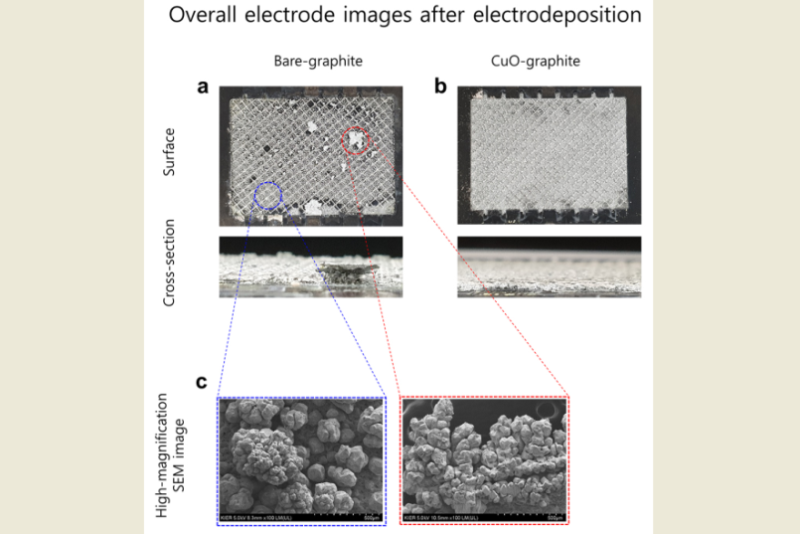
Electrons meet zinc ions at electrodes in zinc-ion batteries, to form metallic zinc that may accumulate as dendrites. But in this instance, the copper oxide nanoparticles combined with the electrons, enabling them to deposit evenly on the anode.
The copper-oxide nanoparticles thus became a virtual electron sponge, that ‘mopped up the dendrites’ before they formed. This suppressed the dendrites, which require uneven zinc growth to appear.
However, the researchers are not sitting back, as their electron sponge mops up dendrites forming so they cannot take hold. Their copper oxide nanoparticles combined with zinc electrons, and that made the difference!
But they released their hold as the battery began to discharge. The zinc coating on the cathode released the ions so the cycle could continue, and offer fresh hope to zinc-ion batteries.
More Information
Novel Current Collector for Zinc-Ion Batteries
Spoonful of Sugar Stops Aqueous Dendrites
Preview Image: Group Photo of Research Team