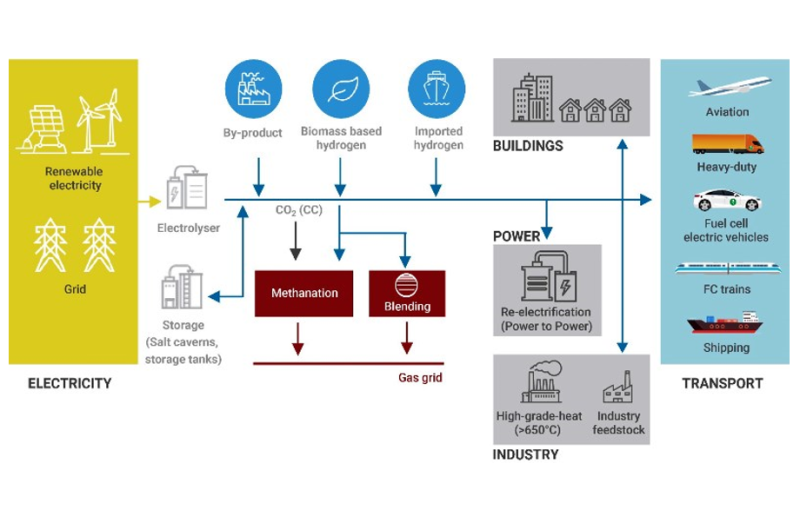
Hydrogen gas is an energy carrier we can deploy in a number or ways, as we depict in the image above. Moreover, the twin components of water, hydrogen and oxygen are in abundant supply. Our scientists have already proven we can use the flammable gas to generate electricity, and power land, sea, and air transport. Today we examine technology for extracting hydrogen gas from the ocean, and progress being made in Namibia.
Electrolysis and Extracting Hydrogen from Water
Electrolysis, or water splitting uses electricity to decompose water into hydrogen and oxygen gases. German and Dutch scientists first achieved this in 1789 in a Leyden jar of water, although they did not take it further. The principles remain the same:
1… First, place two metal plates, typically inert platinum or iridium in water a suitable distance apart.
2… Then connect DC power to these, making them effectively cathode and anode electrodes.
3… Hydrogen and oxygen then leave the water and collect at the cathode and anode respectively.
Hydrogen gas can be accumulated and used for various purposes. However, the technology has remained dormant until recently. That’s because it is cheaper financially to extract hydrogen from fossil fuels.
Fresh Impetus for Extracting Hydrogen Gas From the Ocean

However, we do have an abundance of water in the ocean, and levels will rise further with global warming. So if we add renewable wind and solar power to the mix, we just need a suitable venue to get started. Lüderitz on the Skeleton Coast of Southern Namibia is pushing hard to become a ‘hydrogen super power’.
We have everything we need for this, a member of the town council says. We are right on the doorstep of the Atlantic Ocean with abundant sunshine. Moreover, windy conditions are quite common due to the cold Benguela current running along the coast.
Planning includes appointing a chosen contractor, for a project life of 40 years to justify the investment. A four-year construction period will follow, generating 15,000 direct jobs. When the project is up and running it will need 3,000 full-time employees, 90% of them locally sourced.
Recent Posts
Lead and EV Batteries Advanced Safety Tips
Commercial & Industrial Batteries: Safety Tips
Preview Image: Hydrogen in Green Economy