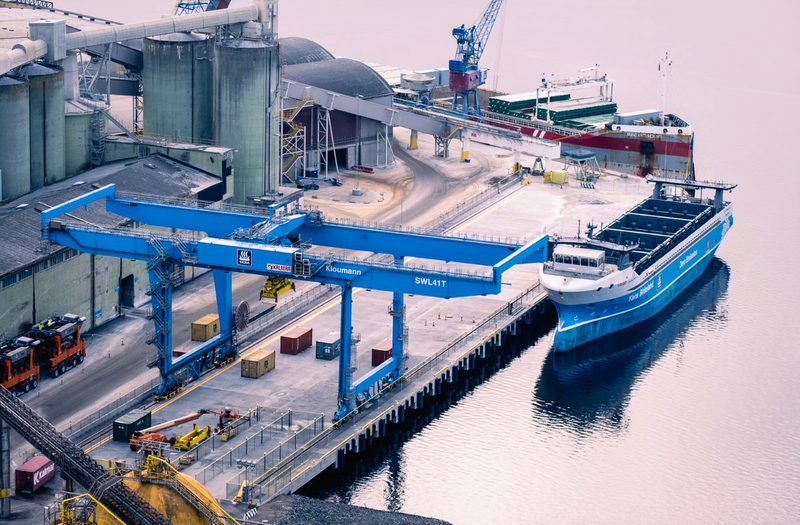
The Yara Birkeland is an autonomous bulk container ship, commissioned in 2022, and running entirely on batteries. The vessel regularly transports fertilizer along a narrow, twelve-mile ocean inlet in Norway. The fully electric Yara Birkeland is a proof-of-concept vessel, capable of multiple purposes and longer journeys.
Technology Behind the Fully Electric Yara Birkeland Ship
The batteries are rated 6,600 volts in total, and 6,800 kilowatt hours according to Wikipedia. These provide energy for two adjustable 900-kilowatt azimuth pod propellers, and two 700-kilowatt tunnel thrusters.
The Yara Birkeland battery ship is capable of 11 miles per hour, with an optimal speed of approximately half that rate. The bulk vessel measures 260-feet from bow to stern, 49-feet across, and 29-feet from the deck to the keel.
The ship takes its name from its owner, Yara International, and the renowned Norwegian scientist Kristian Birkeland. Birkeland is perhaps best remembered for describing electrical currents in the atmosphere in 1900, that cause the aurora borealis Northern Lights.
More About the Project Behind the Electric Container Ship
The project was a revolutionary idea when Yara International proposed it in 2017. After all, Kristian Birkeland founded Yara International in 1905, to tackle the emerging famine in Europe.
Since then, the company has become a global crop nutrition provider. Although, as a green side-shuffle, it also operates a hydrogen demonstration plant at its ammonia production facility in Porsgrunn, Norway.
It therefore seems likely that Yara International was breaking new ground, when it decided to build the world first fully electric Yara Birkeland vessel in 2017. The company joined forces with international knowledge-based Kongsberg Group, that regularly supplies technology systems and solutions for the oil and gas industry.
A Yara International press release estimates that transporting fertilizer along a narrow, twelve-mile ocean inlet, will save 40,000 diesel-powered truck journeys every year. This will reduce nitrogen oxide and carbon dioxide emissions, improve road safety, and reduce road dust and traffic noise too.
More Information
Feasibility and Cost of Electric Shipping