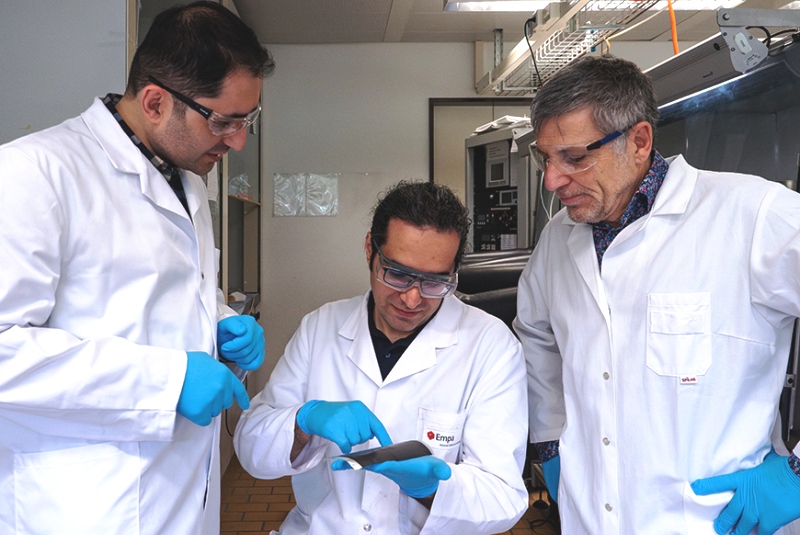
Swiss Federal Laboratories for Materials Science and Technology (EMPA), has conducted application-oriented material science and technology research since 1880. EMPA researchers are currently developing graphene supercapacitor electrodes, with an eye on large-scale commercial manufacture.
Why Do We Need Graphene Supercapacitor Electrodes?
Batteries and supercapacitors play different roles in the evolving world of energy storage. We can compare agile supercapacitors to lightweight athletes, because they charge and discharge small amounts of energy almost instantly.
Whereas batteries are like heavy weight lifters in a gym. They take on more energy, but they do so at a far slower rate. However, the two devices may still team together, as in electric vehicle regenerative braking for example. There, supercapacitors capture the energy, and pass it on to primary batteries to store.
We have often pondered over combining the best of both worlds. We imagine more nimble batteries discharging and recharging faster, and supercapacitors storing more energy in our ideal world.
Researchers at EMPA have picked up the baton. They have embarked on a project to build graphene supercapacitor electrodes that store more energy. Graphene is a two-dimensional form of graphite, that is already improving conductivity as a coating on electrodes in lithium-ion batteries.
Towards Increased Density for Novel Supercapacitors
Density is a measure of how much electrochemical energy a battery, or a supercapacitor, can store relative to their weight, or the volume of space they occupy. However, EMPA is more interested in increasing supercapacitor density, rather than setting a new record that may not be commercially sustainable.
Batteries store their electrons between layers making up their electrodes, while supercapacitors pack them on their electrode surfaces. This difference makes the two-dimensional graphene feasible. In the words of their researchers, it’s the surface not the size that matters.
Graphene has not been straightforward to mass-produce until now. However, the EMPA researchers have solved this, by ‘exfoliating’ graphene from graphite in the form of a printable ink. But they have more to do, before they reach their goal of ‘a real, reliable product’, in their own words.
More Information
Graphene Cathodes Enhance Conductivity
Graphene Enhancing Batteries in Sri Lanka