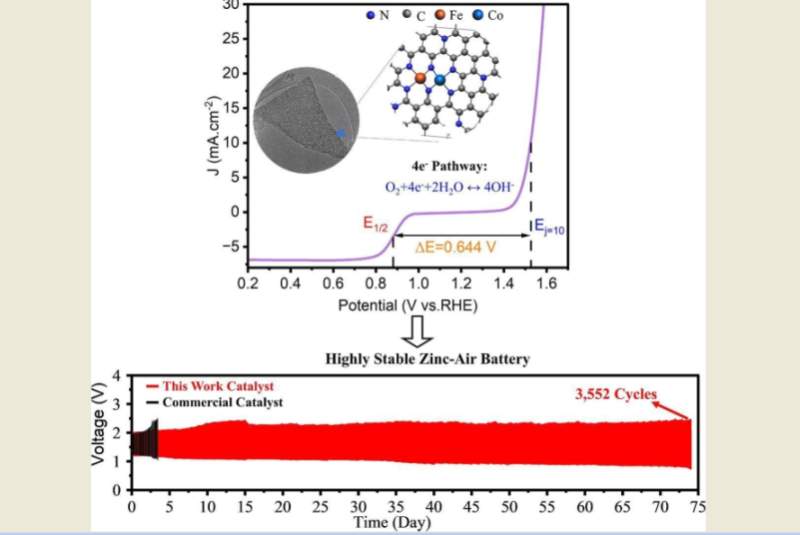
There’s great news for hearing aid batteries (and their users) coming out of Monash University in Australia. Their scientists have come up with a new, bi-metallic catalyst that speeds up the oxygen reaction release. This discovery could make zinc-air hearing aid and other metal-air batteries more powerful, more efficient, and longer-lasting, if commercialized.
This Is Great News for Zinc-Air Batteries
All metal-air batteries can make a significant contribution, because their cathodes are transient fresh air, which is free and non-toxic. Having a ‘virtual cathode’ like that, also helps contain the weight and size of these energy-storage cells.
There is, however, a pressing need to enhance their oxygen redox reactions, to optimize them, and to improve their energy storage. Enhancing these factors would benefit both metal air, and fuel cell chemistries.
These technologies have to date relied on single metal catalysts. These are not ideal, although the search for a bi-metallic catalyst has proved elusive. That said, the team from Monash University appear to have found a contender, in the form of a cobalt-iron derivative CoFe-2DSA material.
This practical solution involves doping the bi-metal catalyst onto two-dimensional carbon nanosheets, and synthesizing the result using salt-assisted heat treatment. This method delivers a stable material well-suited for the purpose.
This sounds like great news for hearing aid batteries, and their users and patient partners all over the world.
More Good News for Hearing Aid Users
The Monash University announcement confirms the following benefits that accrue from the new zinc-air bi-metal catalyst:
- Their smart new design speeds up the oxygen reactions.
- This leads to higher energy storage and greater power.
- The batteries are remarkably stable over thousands of cycles.
Project leader Dr Parama Chakraborty Banerjee observes, “These catalysts do not only solve a key bottleneck for zinc-air batteries. Their design principles can be applied to other clean energy technologies too. These range from fuel cells to water splitting, offering a broad impact across the energy landscape.”
More Information
Dead Volume in Zinc-Air Batteries Activated
Metal-Air Electrochemical Cell Overview
Preview Image: Graphical Illustration of Project