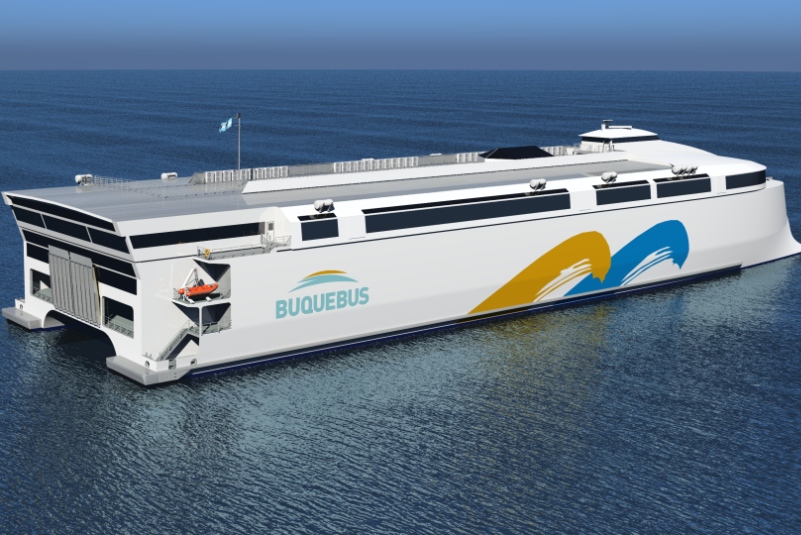
The INCAT 96 battery electric ship is taking shape, at the INCAT shipyard in Tasmania, Australia. After launching and formally renaming, the vessel is the largest working fully-electric ship in the world. The new vessel will join the Buquebus ferry fleet in South America. We wrote this post to celebrate a significant step on this its journey from keel laying, to entering service.
INCAT 96 Charges Its Electric Batteries
IEEE Spectrum made the announcement on November 6, 2025. They confirmed the vessel was “testing the limits of what megawatt-scale charging and battery storage can do”. In plain English this means the INCAT 96 battery electric ship was charging its main batteries for the first time.
The battery electric ferry now has almost 90% of these batteries installed. The vessel sponsor, Buquebus, claims this array is four times larger than any other electric ship.
To give an idea of what that means, the forty-megawatt energy storage system has twelve giant battery sets. These are in 418 modules shared across four rooms housing a total 5,016 lithium-ion batteries.
Cooling the Giant Marine Battery Array
Keeping 250 tons of lithium-ion battery banks cool is a critical safety factor. “Systems of this size require appropriate thermal management,” according a specialist who spoke to IEEE spectrum.
“This includes temperature monitoring and cooling systems. But the primary safety focus is thermal runaway prevention and containment.”
The individual battery modules are accordingly each kept cool by independent fans, with a “layered approach” to safety. Single cell isolation is a key safety element too. This helps ensure that if any cell goes into thermal runaway, it does not spread to the neighboring cells.
More Information
World’s Largest Electric Ship Counting Down
A Greener Way to Cruise the Fjords