The World Health Organization study of the coronavirus outbreak in Wuhan, China was always going to be constrained. That’s because every word of the report required approval by both China and the team of international scientists. We agree due caution was essential. However, the net result is an inconclusive World Health report, that leaves most questions unanswered in terms of mainstream science.
Core Findings in Inconclusive World Health Wuhan Report
The international scientists worked within the constraints of four week visas, of which they spent two weeks in quarantine. However, their joint study did conclude the virus arrived in humans through an ‘intermediate animal’ according to New York Times.
Moreover, it recommended blood bank surveys for cases that might have been present earlier, and tracing potential sources at wildlife farms. However, a semi-informal group of scientists has criticized these findings. That’s because they believe ‘critical records and biological samples that could provide essential insights into pandemic origins remain inaccessible’ to investigators.
Jamie Metzl is senior fellow of international policy think tank Atlantic Council, and signatory to the group’s open letter. ‘This is not about ganging up on China,’ he told New York Times on April 7, 2021. But his group wants to see biosecurity and biosafety experts participate in a follow-up COVID-19 study.
Criticisms of the Inconclusive World Health Wuhan Report
The letters Jamie Metzl and his colleagues signed contain several clauses that, if correct are cause for concern.
1… The joint study team ‘did not have the mandate, the independence, or the necessary access to carry out a full and unrestricted investigation into all the relevant SARS-CoV-2 origin hypotheses’
2… The joint study team ‘saw its priority as seeking a zoonotic human-animal origin, not as fully examining all possible sources of the pandemic … its terms of reference did not mention any possible lab pathway’
Calls for Further Action and Investigation
The letter concludes with a call to ‘leave no stone unturned in seeking to understand how this catastrophe began’. World Health Organization’s Tedros Ghebreyesus agrees the mission’s consideration of a possible lab leak was not ‘extensive enough’.
‘Although the team has concluded that a laboratory leak is the least likely hypothesis,’ he says. ‘This requires further investigation, potentially with additional missions involving specialist experts, which I am ready to deploy.’
Related
Assessing the Infection Risks of Wildlife Trade
COVID Virus Could Cycle Back to Wildlife
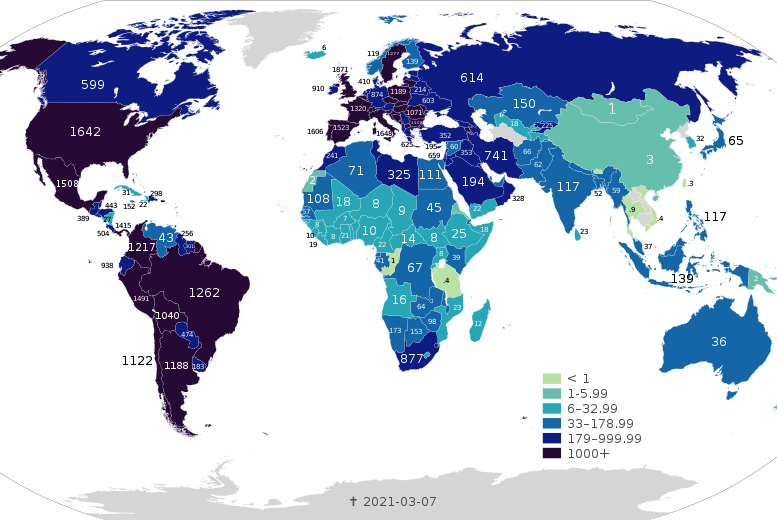
Preview Image: World Deaths per Population