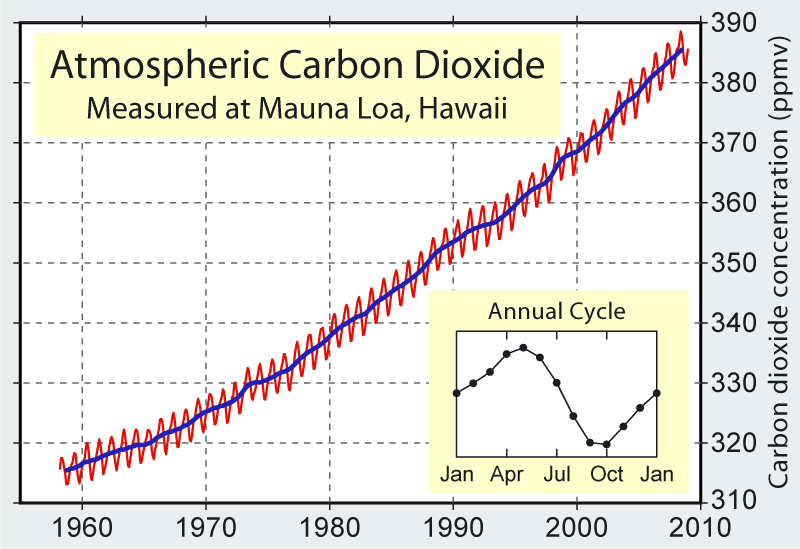
Mauna Loa is a mountain in Hawaii reaching to 13,679 feet above the ocean. Climatologist Charles Keeling placed an observatory on its high slopes in 1958. Because he wanted to create a baseline relating to climate change in a remote place far from human settlement. His first round of readings put CO2 concentrations at 315 parts per million. In 2008, fifty years later these were 20.6% higher at 380 parts per million.
The Mauna Loa Observatory, And the Keeling Curve
Charles Keeling was the first person to alert the world that human activity was causing the greenhouse gas effect, and global warming.
First, he developed a device to measure carbon dioxide in atmospheric samples. Then later, he used his new invention to measure the level of carbon dioxide over time, and found that it had risen since the 19th century.
Keeling correlated his finding with development since the first industrial revolution, and depicted the results in the now famous Keeling Curve. After two years of readings at Mauna Loa observatory, he announced that carbon dioxide levels were still rising steadily. However, the National Science Foundation promptly withdrew its financial support, describing his findings ‘routine’. However, Charles Keeling persisted with his work, and received the Medal of Science in 2001.
How the Work Continued on Mauna Loa Observatory

Charles Keeling, followed by his son Ralph, and later Elmer Robinson continued visiting Mauna Loa Observatory and monitoring the instruments.
Their pioneering work became part of the remit of the Earth System Research Laboratory. This in turn is part of the National Oceanic and Atmospheric Administration (NOAA) of the United States of America.
The NOAA believes Mauna Loa Observatory is the world’s oldest continuous CO2 monitoring station, and the world’s primary benchmark site for measurement of the gas. Charles Keeling was a humble man, and an enthusiastic outdoorsman. He made many hiking and camping trips throughout his life, particularly to the Cascade Mountains of Washington state.
Related
Climate Change Part 12: The Keeling Curve
Climate Change Part 27: 2006 Emissions Reach 8 Billion Tons
Preview Image: The Mauna Loa Observatory