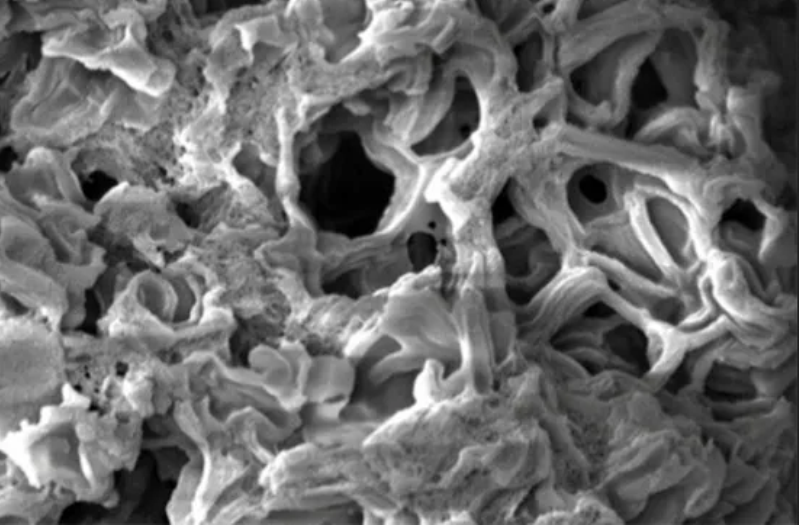
The electrons in a battery have to enter and leave the electrodes via their surface area. The size of this area ultimately determines the amount of current that a battery can produce. A research team at Cornell University’s Giannelis Group has produced a nanoporous carbon material with the highest surface area on record.
Their Nanoporous Carbon Has an Almost Unimaginable Surface
Tech Radar puts this achievement in context, with an example of a teaspoon of the nanoporous carbon material. With all its convolutions, they say, the total surface area would be the size of eleven baseball courts.
The Gianellis Group’s news flash of December 18, 2024, that we link to below , reveals how the team took inspiration from rocket fuel that expands exponentially as it ignites. Their discovery is already proving beneficial for energy storage and carbon-dioxide capture.
The porosity, or holes in the material’s surface expose a greater area for absorbing pollutants, the researchers emphasize. And particularly for storing electrical energy, which is a high-profile focus area of this blog.
“Having more surface area per mass is very important,” adds the senior author of the report. “But you can get to a point where there is no material left. It’s just air.”
“So the challenge is how much of that porosity you can introduce, and still have structure left behind, along with enough yield to do something practical with it.” But how would they achieve this balance?
The Path That Took Them to Their Remarkable Break Through
The team set out to understand, and control the complex reactions that occur in rocket fuel:
- Their process began with developing a material to help shape the carbon into a structured form.
- When they mixed this material with specific reactant chemicals, the compound ignited.
- This reaction formed carbon tubes with a high concentration of reactive molecular rings.
- The team etched away the less-stable structures, creating an intricate network of microscopic pores.
The resulting nanoporous carbon achieved a volumetric energy density of 60 watt-hours per liter when tested. This is four times greater than commercially available activated carbons, and shows promise in energy storage.
More Information
Twisted Carbon Nanotube Batteries On the Go
Metal Nanoclusters in Lithium-Sulfur Batteries