Metal nanoclusters are very tiny objects comprising up to several hundred atoms, inside core-protective agent shells. Scholarly Community Encyclopedia explains how their unique geometric and electronic structures enable them to bridge the gap between molecules and nanoparticles. However, until now scientists have found very few practical applications.
Stabilizing Lithium-Sulfur Batteries With Metal Nanoclusters
Researchers at Tokyo University of Science recently discovered a way to use metal nanoclusters to stabilize lithium-sulfur batteries. This is a remarkable step forward, because lithium-sulfur could potentially store three-times more energy that lithium-ion. This discovery comes at a time when the demand for safer, more efficient energy storage is pressing.
Lithium-sulfur technology has previously faced apparently insurmountable obstacles. Among these is the tendency for capacity loss, as lithium polysulfide species form during ion shuttling between cathode and anode. This ‘shuttle effect’, as battery scientists call it, rapidly reduces battery life and performance.
Much work has been done to previously tackle this problem. There has been some success with countering expansion of sulfur cathodes, dendrites, and the formation of lithium-sulfur species. However, these have all involved trade-offs that made the modified technology a less-attractive alternative to lithium-ion.
An Innovative Approach to Resolving This Problem
This is not to say the Tokyo University of Science team were the first to consider using metal nanoclusters. There have been several theoretical suggestions before, although all failed the acid test of being practical. Thus the Tokyo discovery really does break new ground.
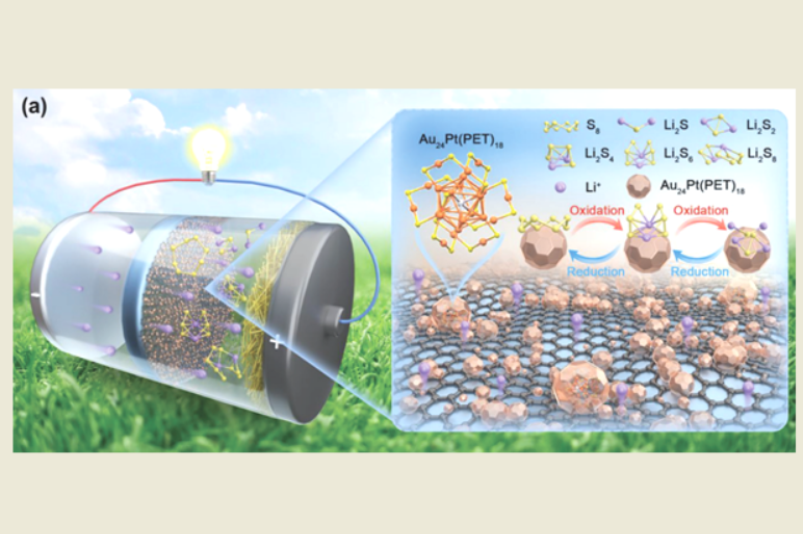
The university’s press release (see link below) explains their team “harnessed the surface-binding property and redox activity of platinum nanoclusters as a high-efficiency electro-catalyst in lithium-sulfur batteries.” This modification arrested the ‘shuttle effect’ and the development of dendrites, while retaining storage capacity after 1,000 cycles.
More Information
Comparing Lithium-Sulfur & Lithium-ion Cells
Talk for Five Days on Lithium-Sulfur Power
Preview Image: Modified Lithium-Sulfur Battery
YouTube Share Link: https://youtu.be/Yo_HiFoqN7M?si=yioAyvORArUnUpOc