The other electronic components we have been writing of transfer a set amount of current, but a potentiometer is variable. Thus unlike mosfets, resistors, diodes, and transistors, potentiometers have adjustable controls. So we can set the current leaving them in gradients between zero and what they receive up front. In other words, they are variable resistors, or rheostats.
The Principles behind a Potentiometer

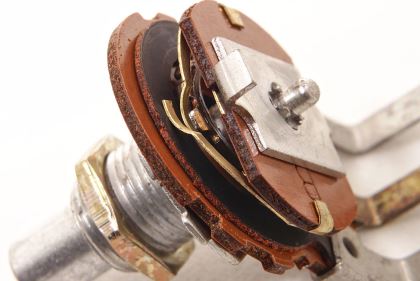
Potentiometers – those in the know call them ‘pots’ – are three-terminal resistors with sliding or rotating contacts permitting adjustable current flow.
Mechanical ones comprise resistant material – often graphite – and a variable ‘wiper’ the user sets to increase, or decrease the accumulated resistance.
Digital potentiometers provide a similar service, except in their case the process is automatic. Since they require more than a finger twiddle to adjust them, these are the preferred solution for critical equipment.
Since potentiometers consume the current they absorb, they are economically unsuitable outside of low current applications.
The Practical Benefits of Using Potentiometers

However, a potentiometer really comes into its own where the interface invites the user to set their preferences. It is the secret sauce behind the variable windshield wiper, and the dimmers in the living room lights.
Linear and rotary potentiometers are an essential part of audio equipment where they enable us to adjust for frequency, sound and other variables.
The Touch-Sensitive Membrane Potentiometer
In this relatively new application, a sliding element deforms a flexible membrane in order to contact a resistor-contact divider. Depending on manufacturing standards, this process can sustain between one and twenty million cycles. In the case of touch-screen devices, membrane potentiometers provide x-y coordinates a processor interprets.
Click this link if you want to know more about how a membrane potentiometer works in practice, as the technology is too complex to write up here.
Related