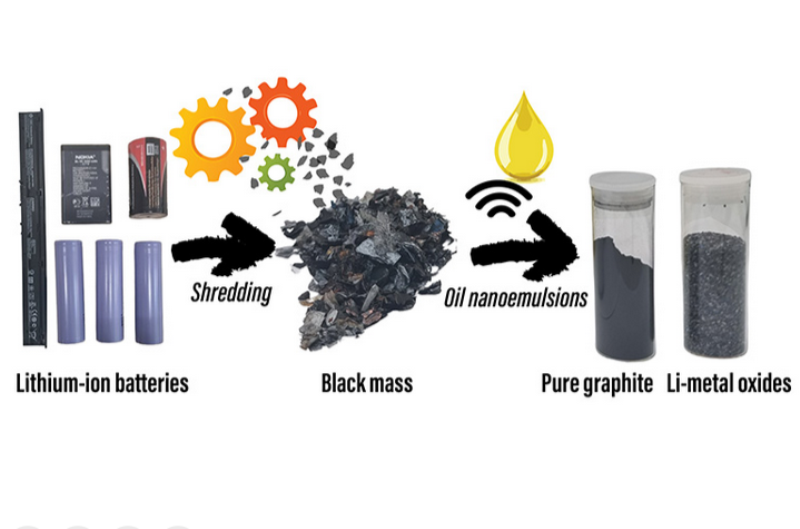
Black mass is the residue that remains, after shredding batteries to recover their materials. Depending on the battery design, these materials could include lithium, cobalt, and nickle, in the case of lithium-ion.
The most popular methods for recovering these materials include hydrometallurgy and pyrometallurgy, using toxic chemicals. But now scientists at University of Leicester, UK, have turned theory on its head, by purifying battery black mass using vegetable cooking oil.
A Trace of Cooking Oil Purifies Lithium-Ion Black Mass
A research team under guidance of Professor Andy Abbott, and Dr Jake Yang, have found a novel way to recover crushed lithium-ion battery anodes and cathodes. In a remarkable touch of irony, they achieved their goal with pure water and a dash of cooling oil.
Their logic is so simple we find it hard to believe, after others invested their efforts in hydro and pyrometallurgical recycling. As we should know after washing up dishes as kids, oil does not dissolve in water, unless we add soap. Earlier research has already opened the door, by creating long-lasting nano-oil-droplets using ultra sound.
The University of Leicester team cooked up a new recipe using this knowledge, and came up with this new way of purifying battery black mass, using water with a dash of vegetable oil:
- Their lithium-ion black mass contained a mixture of carbon graphite, and valuable lithium, nickel and cobalt metal oxides.
- The nano-oil-droplets adhered to the surface of the carbon graphite particles, acting as a glue to bind them together.
- This binding created large oil-graphite conglomerates, which floated on the water-vegetable oil solution, for skimming off.
- The valuable hydrophilic lithium metal oxides meanwhile remained behind untouched, and ready for subsequent recovery.
The battery-grade crystalline structures of the metal oxides were not destroyed in the process, as occurs during hydro and pyrometallurgical procedures. They were ready to be fed back directly into next generation lithium-ion battery cells. So, is there a catch to purifying battery black mass this way? We can’t see one right now, as we write.
More Information
Mercedes Launches a Hydrometallurgy Plant
Processing Battery Black Mass at End of Life
Preview Image: Recycling Lithium Batteries With Vegetable Oil