The R Factor is the basic reproduction rate of something, anything that becomes more or less. America’s R Rate for couples, in terms of children was theoretically 2.4 when that was everybody’s dream. It guided economic and urban policy. Meanwhile, in China the government was more interested in one-child families. Today we examine the R Factor compass of infection direction in the context of COVID-19
Is the R Factor a Misunderstood Compass of Infection Direction?
Using the R Factor as single metric can be a distraction, unless we take it in the broader context. In theory, a national R Value above one means an outbreak is growing, and below one means that it is shrinking. However, a single measure can obscure local trends, unless we distill it down to geographic areas, and know the direction it is moving there.
Nature.Com was concerned world leaders were politically fixated on the measure on July 3, 2020. Do you remember those days we were damping down the embers of the first surge, and feeling on top of things? Mark Woolhouse, infectious-diseases expert at University of Edinburgh in United Kingdom said his country had ‘created a monster’.
That’s Because the R Factor Does Not Tell Us How to Manage It
Perhaps we need to go back in time, and delve into science to understand Mark Woolhouse’s concerns back then. Scientist’s originally developed the R Factor to measure population growth. This was increasing, but so slowly they did not need to know the speed this was happening. However, we do need to know how rapidly the pandemic is accelerating, or slowing down.
This is the weakness of using the R Factor compass of infection direction in isolation. And not digging deep enough so we understand the dynamic of the drivers. The R Factor is a lagging indicator that reports events when it is too late to do much about them. This underscores the importance of testing, which reflects events more currently as they happen.
Related
New Antibody Trial Offers London Some Hope
Dreaming of a Safer Christmas In 2021
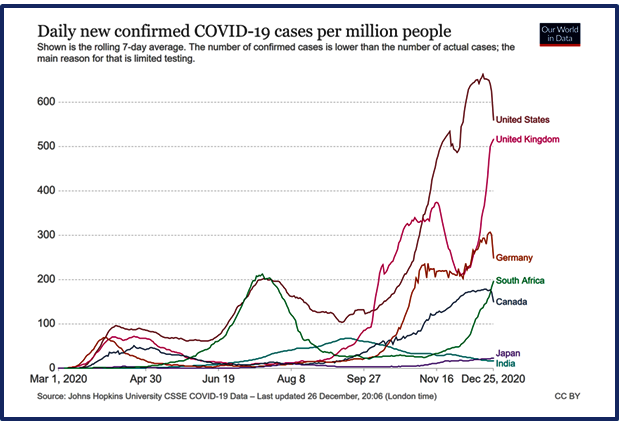
Preview Image: Daily New Confirmed Rates