It has become increasingly obvious that the oil industry thinks it has an inalienable right to do as it wishes. Take those immense supertankers that carry crude oil around the world. If asked what happens to them when they are old, they might say “Oh we suppose someone somewhere will break them up. That’s progress, that’s the business we are in.” On July 1, 2019 Richard Gray writing in Future Now raised the possibility of rehabilitating old oil supertankers instead.
Rehabilitating Old Oil Supertankers For a Greener Future
As I write this, Richard says, “There are around 10,420 giant ships heaving their way across the world’s oceans. Their enormous metal bodies lumber onwards in spite of inclement weather and rough seas. In their bowels, these beasts are carrying 3.8 billion barrels of crude oil between them.”
Moreover, everything we create from their sticky oil will eventually end up as garbage, we might add. Plastic bags blowing in the wind, drinking straws carelessly dropped, old clothes worn out, and yes carbon dioxide gradually suffocating Earth’s systems. If we could find a way of rehabilitating old oil supertankers into something useful, at least they might have a more noble purpose.
We Have an Urgent Need to Start Doing So Now
As we wean ourselves off fossil fuel, two things are changing. In the first instance we need more renewable electricity generation. In the second, we need fewer and fewer oil supertankers. How about, Richard asks we turn them into vast sources of clean, renewable energy?
An Ocean Energy Generator Effortlessly at Work
Rehabilitating old oil supertankers into floating power stations is an immense, but doable thought. Engineers believe we could use their giant hulls to capture the restless energy of the oceans. Most tidal turbines are tethered to the shore. However supertankers could cruise across the oceans chasing storms with biggest waves. The water rising and falling in vertical tubes running through them would convert into rotational power like a giant piston.
This energy could power medium-size factories on decks of working ships processing materials. They could also desalinate sea water on board, and transport it to areas most affected by global warming.
Related
An Australian Oil Rig on Battery Power
Upper Ocean Warming is Strengthening Waves
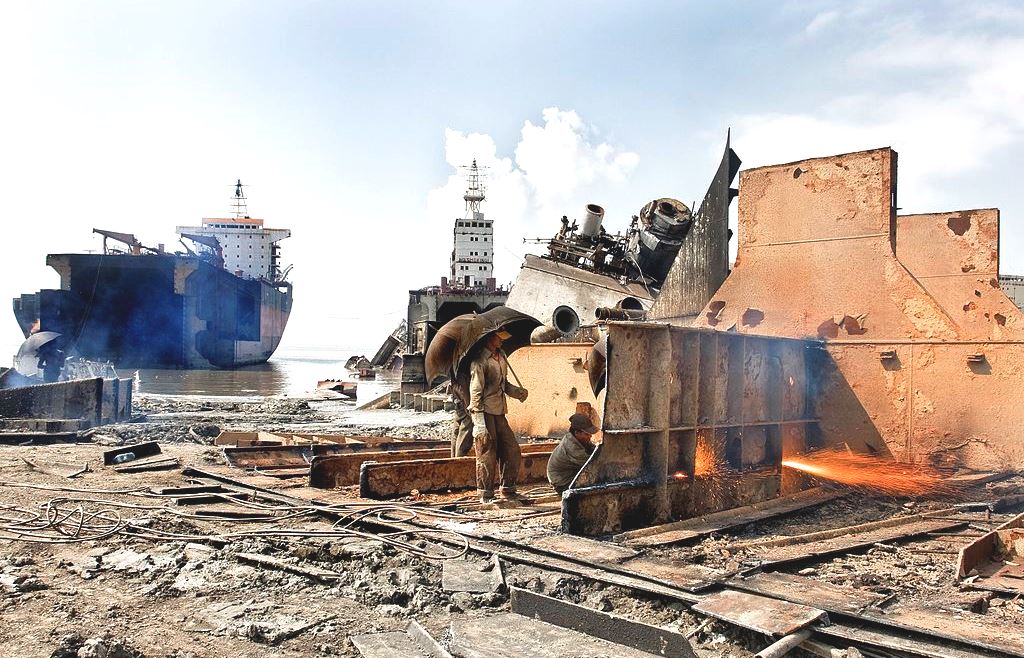
Preview Image: Gas cutting in Chittagong, Bangladesh
Video Share Link: https://youtu.be/hSHgqTCh42A