Researchers from Doshisha University in Japan, have developed a safe efficient lithium-ion quasi-solid battery for electric vehicles, and devices. However, at this stage their work is at laboratory, prototype phase. This implies that global concerns over the longevity and safety of conventional lithium-ion batteries are not over yet. The key lies in combining solid and liquid electrolytes.
Innovative Approach to Safe Efficient Lithium-Ion Batteries
Lithium-ion batteries have become so commonplace, that we hardly remember they are in our trusted vehicles and phones. They use a flammable liquid organic electrolyte, that assures they are efficient. But unfortunately, with that efficiency, comes a measure of fire risk.
Solid-state lithium batteries may resolve that risk of fire, but unfortunately this comes with less-efficient ion transfer. And furthermore, expansion and shrinkage of solid electrolytes can disrupt ion transfer further.
Therefore, the researchers from Doshisha University in Japan reasoned, they needed to develop more efficient solid-state batteries. Options with stable joint interfaces that could simultaneously enhance their safety, utility, and performance.
Stable Joint Interface To Enhance Safety, Utility, And Performance
The team of researchers from Doshisha University developed a non-flammable, quasi-solid-state lithium-ion battery. Follow the link to the Journal of Energy Science below, to learn how they overcame the limitations of conventional batteries. We can only provide an overview here.
The main author of that paper, Ryosuke Kido explains as follows:
- Increasing the capacity of the positive and negative electrode active materials, achieves higher energy density while reducing cycle performance and safety.
- The flame-retardant quasi-solid-state battery we developed, combining a liquid electrolyte and a solid electrolyte, provides a safer and more durable alternative to all-solid-state batteries with high energy density.
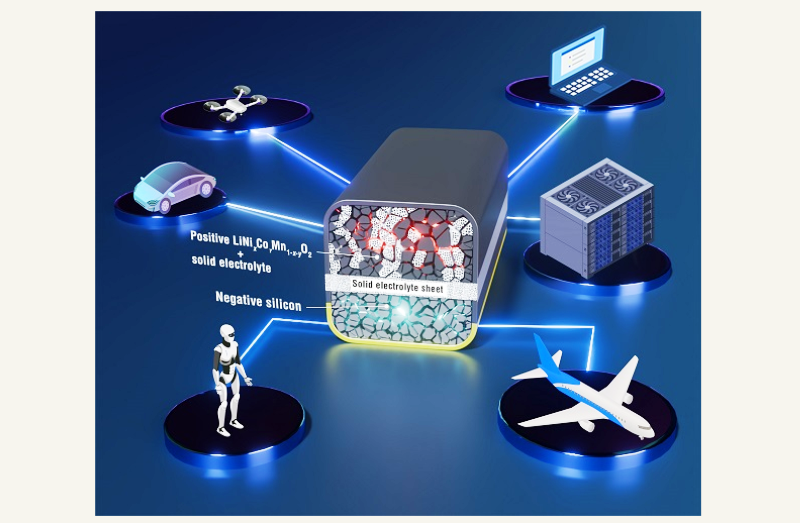
This novel, safe efficient lithium-ion battery that the team developed, combines a silicon negative electrode, paired with a lithium-cobalt-manganese positive electrode. A glass ceramic sheet separates these two electrodes, while allowing free passage of lithium-ions.
Individually tailored, non-flammable, nearly saturated liquid electrolyte solutions, surround each of these electrodes separately. These liquid electrolytes demonstrate excellent ionic conductivity, thermal stability, and electro-chemical performance too.
Overall, the Doshisha University report concludes, the newly developed lithium-ion battery has great potential. That’s potential to enhance the development of efficient, and safer, next-generation electric vehicles, and cordless appliances like drones.
More Information
The Solid State Battery Game Changer
Reducing Resistance in Solid State Batteries
Preview Image: Sage Efficient Lithium-Ion Battery