The COVID-19 disease killed 3.8 million people, although this virus is not unique. That’s because it’s a member of the coronavirus family of respiratory viruses. Researchers discovered shadows of an ancient version that broke out 20,000 years ago. After they found biomarkers in descendants living today.
Two other members of the coronavirus family appeared in the past twenty years. These caused the SARS and MERS outbreaks. And they killed 800 and 850 people respectively.
What Can We Learn from this Ancient Coronavirus?
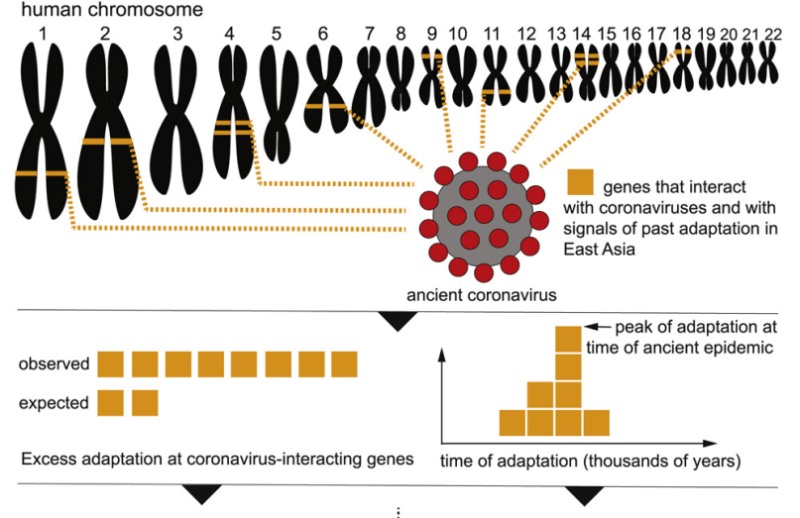
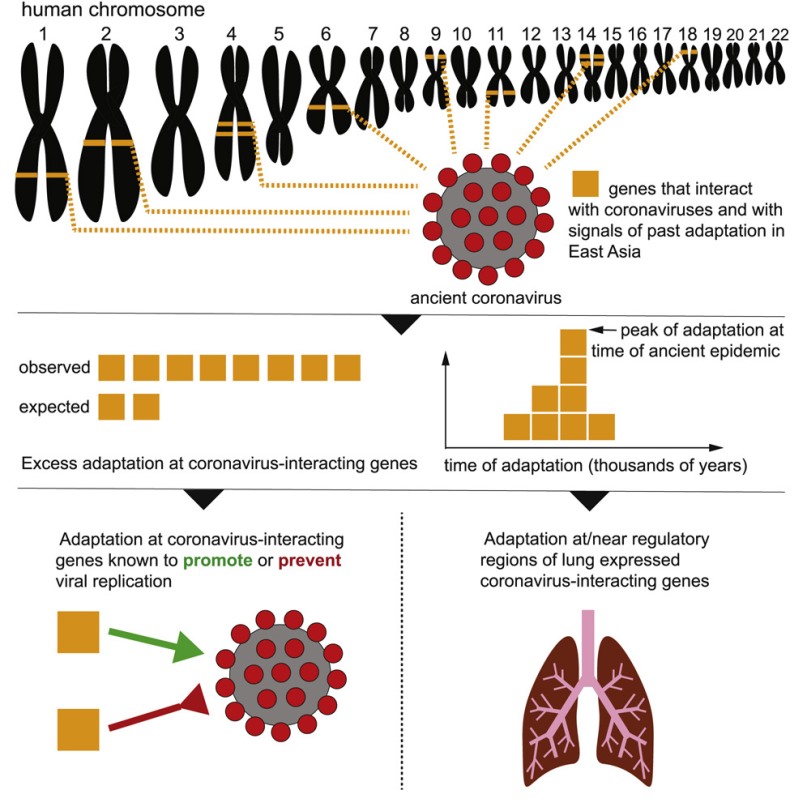
The scientists first analyzed genetic information from 2,500 subjects representing 26 world populations. Because they hoped to find evidence of previous coronavirus outbreaks. And then learn how our ancestors adapted to them.
They discovered shadows of an ancient coronavirus event that occurred in East Asia region over 20,000 years ago. And moreover, that evidence was in the genetic information of subjects who came from that area.
‘It was like finding fossilized dinosaur footprints, instead of finding fossilized bones directly,’ David Enard told Sci Tech Daily. He is a professor at University of Arizona Department of Ecology and Evolutionary Biology, and also one of the study lead authors.
We Found Shadows of an Ancient Coronavirus
‘However, we did not find the ancient virus directly,’ David Enard continues. ‘Instead, we found signatures of natural selection, imposed on human genomes at the time of an ancient epidemic.’ Moreover, those adaptions are in 42 different genes, and they are primarily active in lungs.
Study co-author Ray Tobler from University of Adelaide School of Biological Sciences sheds further light. ‘Past interactions with viruses have left telltale genetic signals,’ he explains.
‘But this is information we can leverage to identify genes influencing infection and disease in modern populations. And this points in turn to the promise of evolutionary genetic analysis. This could be a new tool for fighting viral outbreaks in future.’
Breaking News
Secondary School Kids Need Vaccinations
No Jab No Fly Policy for New Zealand Visitors
Preview Image: Graphical Abstract from Study