Scientists from College of Engineering at University of Alaska published an open access article on March 1, 2022. Their post reviewed two alternative methods of stationery battery thermal management, and recommended thermal racks to dissipate heat.
This work is important because heat-sensitive stationery battery systems are assuming an increasingly important role. We present a high level summary of their report, and append a link to the full version if you would like more detail.
Stationery Battery Thermal Management Is Critical
Researchers Getu Hailu, Martin Henke and Todd Petersen were concerned battery temperature management is not keeping pace with current practice. They found active forced cooling was the default approach, although scientific validation was largely absent.
More About Their Research, Results and Conclusions
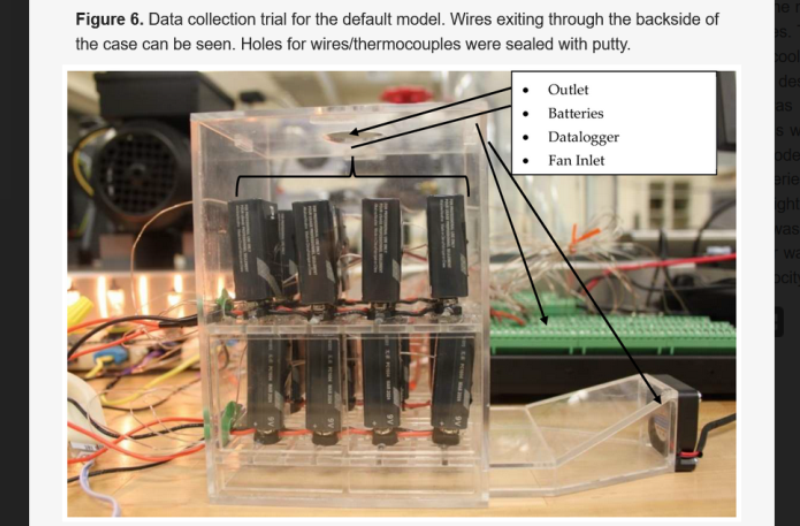
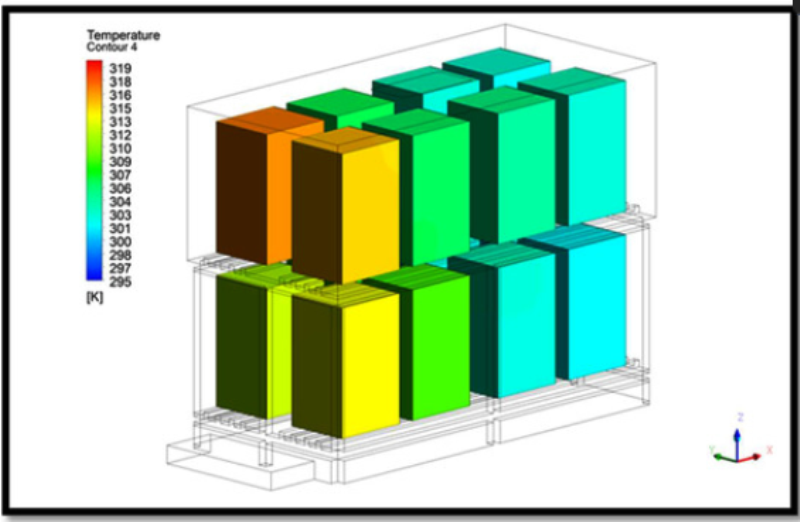
The team developed a virtual model to compare active stationery battery thermal management with passive perforated venting. Hailu, Henke and Todd concluded a perforated vent plate ‘greatly increased cooling performance while simultaneously promoting consistent battery temperature’. They found:
1…Batteries closer to the source of vortex cooling “had higher temperatures, while batteries opposite the outlet were cooler”.
2… But those benefiting with a vent plate were cooler closer to the vent, with temperature slightly higher further away.
The team noticed their 9V Li-Ion batteries reached a point at which their rising temperatures steadied with both cooling methods. They used those temperatures to compare the two approaches. They found the vented method produced 5.2 °C lower temperatures. Moreover, the differential among the batteries was an acceptable 2.7 °C using that method.

Hailu, Henke and Todd conclude both vortex and vented models show enhanced cooling performance. However, a vented design allowed better air mixing, and “drastically reduced” temperature differentials.
They believe commercializing this method would extend battery life, and lower the cost of replacing batteries over time. There was also a saving in the cost of cooling energy. Their next step may be delving into the combined performance of vortex and vented models.
Breaking News
Wind and Solar Achieve a Critical Milestone
Why Do Lithium Batteries Still Catch Fire