COVID-19 tends to spread in clusters that often stem from groups of people together. Noteworthy examples include religious gatherings, dormitories for migrant workers, and cruise ships. Scientists call the degree a disease clusters, the ‘K’ factor when measuring dispersion. A low measure means a small number of people cause the infection. We discuss super spreading and K factors in more detail in this post.
Super Spreading and K Factors of Infectious Diseases
Other infectious diseases also spread in clusters. The K factors for SARS and MERS were approximately 0.16 and 0.25 respectively. Whereas the factor for the Spanish Flu epidemic was around 1.0 suggesting clusters played a lesser role.
Science Mag ascribes a K factor of 0.1 to COVID-19 in terms of research at London School of Hygiene & Tropical Medicine (LSHTM). This means clusters play a significant role in super spreading and K factor scores. Many infected people do not transmit the virus at all. Adam Kucharski of LSHTM says 10% of infected cases are responsible for 80% of the spread.
What This Data Tells Us about Self-Protection from the Disease
These numbers suggest we have a statistically higher chance of encountering a super spreader in a crowd of people. They also help answer puzzling questions about the initial outbreak.
Science Mag suggests most first infection chains from China faded with SARS-C0V-2 because of the K factor. They would have needed to repeat four times to gain a foothold in a new host country. As Adam Kucharski says, most of the China epidemic sparks simply died out.
The risk of contracting a virus depends on super spreading, K factors and situational variables. The spreader may breathe out more than an average person when they speak, or shout or sing songs at a gathering. We learn social distancing is more than face masks. We may need to stay away from social and work groups too.
Related
Incubating and Asymptomatic Virus Carriers
Russia Trialing an Influenza Drug for COVID
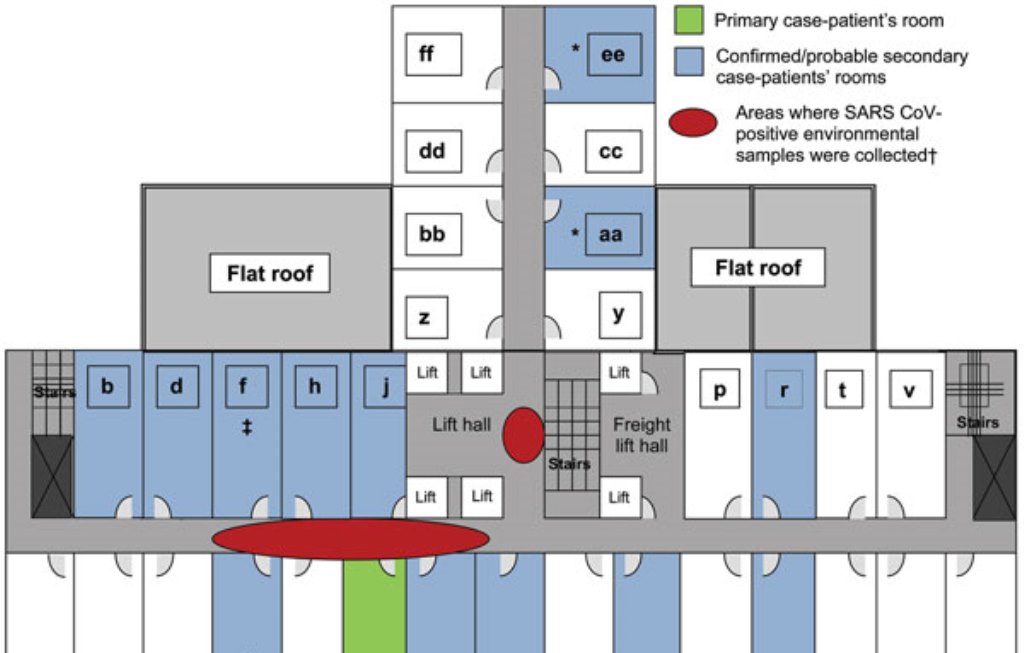
Preview Image: A Super-Spreading Event