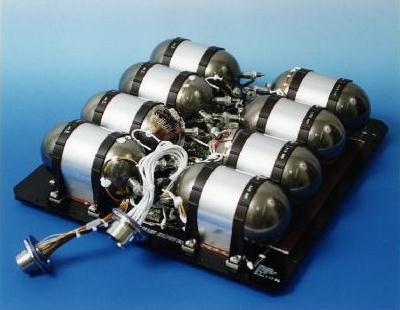
Batteries in space are used in various applications from earth orbiting spacecraft, launch vehicles, space shuttles, crew return vehicles, astronaut equipment, landers, rovers, and planetary spacecraft. Batteries are mainly used as electrical energy storage or as a source of power.
Batteries are used to store excess energy in the event of power system failure because they are a reliable source of backup. Batteries required for space applications must withstand shock, vibration, and acceleration and is capable of operating in a hard vacuum. Batteries should also provide maximum electrical energy in minimum volume and weight.
Long active shelf life up to 10 years and 30,000 life cycles are the driver of planetary probes. Some planetary missions require as low as 80 °C radiation and resistance temperature.
Since no single battery system can meet these requirements, different battery systems are used and custom-designed to meet the requirements of a particular space mission.
Silver Zinc Batteries (Ag-Zn) were first choice in the early days of space missions. It was used in Sputnik, a Russian spacecraft launched on October 4, 1956. It was intended to provide power to the 84 kg spacecraft for three weeks. This primary battery was primarily used for communications and spacecraft operations. There were no solar cells available for charging at that time so communications failed, but Sputnik orbited in space for more than three months. The batteries used on the second Sputnik were six times larger Ag-Zn and lasted for four months.
Nickel-Cadmium batteries (Ni-Cd) were used as a primary battery for Explorer 8, an American satellite launched on August 7, 1959, which survived for three months. In April 1960, NASA launched the first successful long-term low-earth orbit (LEO) weather satellite carrying 21 Ni-Cd cylindrical F-cells batteries with glass-metal seals to insulate the positive terminal from the metal case. This capacity was selected so that the DOD (depth of discharge) is only at three percent. In November 1964, the original prismatic Ni-Cd cell was produced and flown by Explorer 23. In the mid 70s, NASA developed the standard Ni-Cd cells and used the first batch of 20 Ah cells in 20 Ah batteries in Solar Max mission. Ni-Cd became the most common energy storage over the next 20 years.
Nickel Hydrogen batteries (Ni-H2) was first developed in the 1960s, but started to play a role in the 80s. Nickel-Hydrogen batteries are the most reliable because they are cheaper and lighter, but with a long life cycle. Nickel Hydrogen batteries made use of NiOOH electrode from Ni-Cd cells and H2 from a fuel cell. These cells have individual pressure of 400–600 psi.
The replacement of cadmium with hydrogen electrodes has double the energy of Ni-Cd, but the specific energy of Ni- H2 is similar to Ni-Cd because of the cylindrical configuration of the pressure. The first Ni- H2 battery was used in a GEO (geostationary mission) Intelsat V in 1983. Almost all GEO spacecrafts now use Ni-H2 batteries. The first NASA LEO spacecraft to use Ni-H2 was in 1990.
Lithium primary batteries including Li-SO2, Li-SOCI2, Li-BCX, Li-(CF)x, Li-MnO2, are used by planetary probes, rovers, and astronaut equipment. The Li-(CF)x has been used as emergency destruct battery in launch vehicles while Li-SO2 is used in long duration exposure facility. Li-BCX has been used since 1883 for astronaut equipments, and Li-SOCI2 were used by Sojourn Rovers in the DS-2 Mars Penetrator.
Lithium-ion Rechargeable Batteries are lightweight, compact, and was used in Mars 2001 landers, Mars 2003 Rovers, New Millennium ST4, and solar probes. However, the USAF is considering its use in unnamed aircraft vehicles, LEO, and GEO spacecraft.
Fuel Cells – the first use of fuel cells was on the August 21, 1962 Gemini Program. The first of seven Gemini earth orbited manned aircraft was launched with PEM (Proton Exchange membrane) electrolyte cells. While PEM served its purpose in this initial application, it was found out that it did not have the power density capabilities of alkaline type fuel cells.
Future of Batteries in Space
In the next millennium, NASA is planning more exciting space exploration that requires the use of revolutionary technology like batteries that can withstand ultra low temperature from -20 to-100°C and with ultra high G forces of up to 80,000 rigid body shock environment.
In space, batteries should be able to withstand very hot and cold conditions. They must withstand the radiation of the sun and work in a vacuum without leaking or exploding. Most batteries used in space can be recharged by solar cells which converts the sun’s energy to electricity. Lithium-ion Rechargeable batteries are the newer kinds because they can be recharged many times, and they store a lot of energy in a small space.
See also:
Solar-charging batteries