Sodium-ion batteries start with a fundamental disadvantage, because their ions are larger than lithium ones. We could compare sodium ion transport in batteries to large people carriers navigating motorway traffic, compared to small sports cars.
The reality is not that simple, of course. The electrolyte that sodium ions pass through, plays a significant role too. Liquid electrolytes are less satisfactory because their materials are flammable.
Polymer solid electrolytes could be an option, if they conducted sodium-ions faster, and interfaced better with negative battery electrodes. Researchers at National University of Singapore have resolved both these concerns in their laboratory.
Transporting Ions Faster in Sodium Batteries
The Singapore University solution, as they outline in Tech Explore, incorporates a single, affordable additive in a polymer solid electrolyte. This is exciting, because it could open doors wider for sodium-ion batteries.
The additive in question is graphitic carbon nitride. This is an earth-abundant, metal-free, two-dimensional polymeric semiconductor, consisting primarily of carbon and nitrogen. It is also quite straightforward to produce.
In this instance, the Singapore researchers heated carbamide urea to 1,000º Fahrenheit / 550º Celsius. This produced sheets of material an incredible 2 nanometers thin. But how could this improve ion transport in sodium batteries?
A Significant Improvement to Sodium-Ion Batteries
The Singapore scientists incorporated the thin sheets into a polymer electrolyte film. This modified the polymers’ internal structure in several significant ways:
- The new arrangement created zones through which sodium-ions could move freely.
- This doubled the rate at which the modified polymer structure conducted the ions.
- It also transformed the critical interface between the electrolyte and the sodium electrode.
- The electrolyte became more robust, and was able to resist the formation of dendrites.
“What makes our approach powerful is its simplicity,” a researcher explains. “Graphitic carbon nitride can be made from one of the most widely available chemical precursors in the world, and incorporated into a polymer system that is already scaleable.
“That combination of performance and practicality can potentially move the technology towards rapid real-world deployment,” they continue. And that, in a nut shell, is how they improved ion transport in sodium batteries in Singapore.
More Information
What Are Polymers in Batteries?
Solid Polymer Electrolyte Material
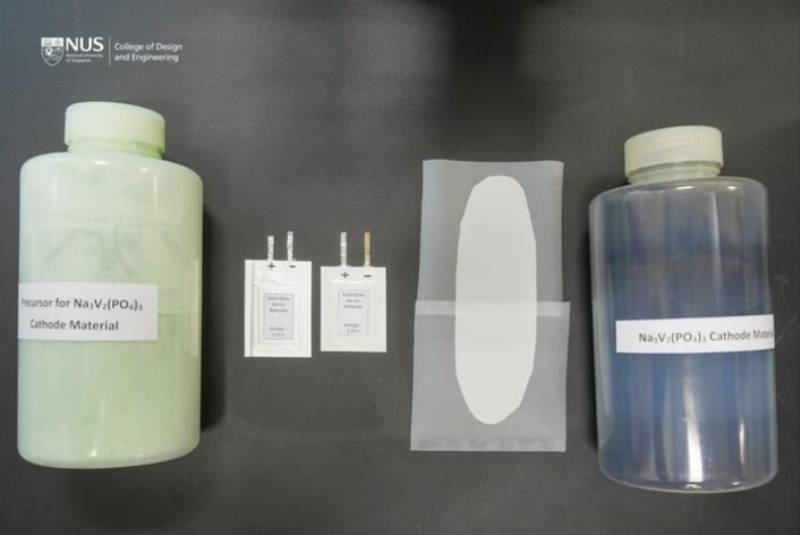
Preview Image: Stages of Development
Research Report in Wiley Online Library