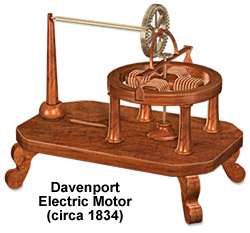
The Davenport Motor is said to be the first DC motor that was created. It is a battery powered electric motor that was so ahead of its time, that nobody really appreciated it when it was created in 1834.
Thomas Davenport (July 9, 1802 – July 6 1851) was a Vermont blacksmith who was inspired to create the Davenport Motor after he heard of the magnet-based machine that was built by Joseph Henry. Henry’s machine was used to separate iron ore at the Penfield and Taft iron works in Crown Point, New York. It gave birth to Davenport’s interest in electricity and magnetism.
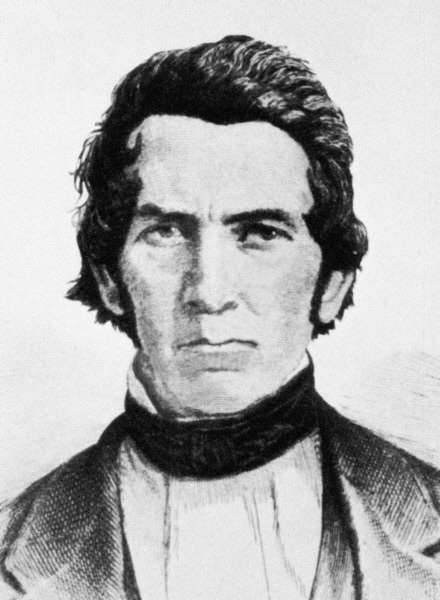
After buying an electromagnet from the factory in Crown Point, Davenport took it apart to study how it worked. He then put it back together, but this time, he forged an improved iron core and remade the wiring. He used the silk from his wife’s wedding dress to help insulate the wiring of the new magnets.
The Davenport motor design used two magnets for the motor. One magnet was mounted on a wheel and the other was attached to a stationary frame. The positioning allowed the magnets to interact with each other so the rotor was able to revolve half-way. While constructing the motor, Davenport realized that reversing the wires to one of the magnets allowed the rotor to complete yet another half-turn. This was how the inventor created the brush and commutator.
Davenport used a galvanic battery (developed by Alessandro Volta) as the electricity source for the magnets. It is a battery that used an electrolyte out of a bucket of weak acid. Apparently, it was this battery that caused his motor to fail commercially. The erratic electricity that was supplied by the Volta-type battery and the expense associated with the creation of the motor made it less practical than the steam engine then currently in use.
Despite of this, Thomas Davenport sought to patent his motor as a device for “Improvements in propelling machinery by magnetism and electromagnetism.” He applied for the patent starting 1834 but he only got the approval (US Patent No. 132) from the US Patent Office in 1837.
Unfortunately, he died before his creation was recognized for its importance by society. His motor paved the way for electrification of streetcars and the electric motor used to convert electrical energy into mechanical energy. This is what we now use for washers, fans and refrigerators.