The largest battery in the world is in Fairbanks, Alaska. At the heart of the world’s most powerful system are a converter and nickelcadmium (Ni-Dc) batteries. The battery is used by Golden Valley Electric Association (GVEA) as backup power to service 90,000 residents in the event of transmission line equipment failure or a power plant outage. The battery weighs about 1,300 tons and the building that houses it measures 120 x 26 meters.
Technical details
The Battery Energy Storage System (BESS) was initially configured with four battery strings operating in parallel, but it can expand to six battery strings to pick up 40 megawatts for seven minutes or 26 megawatts of load for 15 minutes. Each string has 3,440 cells connected in a series.
The BESS battery is comprised of 13,760 “Saft SBH 920” rechargeable nickel-cadmium cells providing a storage capacity of 3,680 Ah and a nominal dc link of 5,000 V. These cells are built into 10-modules mounted in a drive-in racking system. The cells are sitting on a plastic grating, which allows the spills to drain to drain into the module base. The tray can hold the electrolyte content of all ten cells.

How does it work?
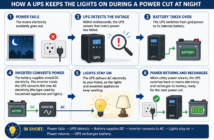
The battery to the power-line allows a seamless switch between the sudden loss of generation to the start-up of back-up generation. The facility can accommodate up to eight battery strings to enable GVEA to prolong the system beyond 25 years of operation without losing the beneficial characteristics of the Ni-Cd batteries. Ni-Cd battery’s pocket plate cells can withstand the stress of repeated discharge with little effect on the life of the battery.
The primary subsystems in the BESS are Ni-Cd battery and the IGCT (Integrated gate-commutated Thyristors). Integrated gate-commutated Thyristors (IGCT) are press pack devices that serve as power terminal contacts. It requires an external power supply and has a power consumption that ranges from 10 – 100 W. Its control functions can be accessed through an optical fiber.
Related articles: