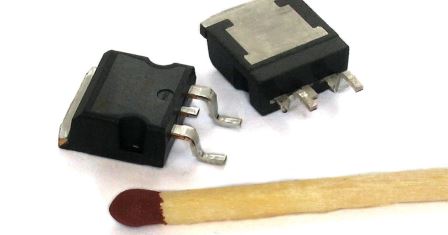
A Metal-Oxide-Semiconductor Field-Effect Transistor delivers a much higher current than it receives. By way of illustration, it can convert one milliamp to as much as fifty amps. This represents a 50,000-times improvement. Imagine of we could do that with our money! Unfortunately, we cannot but we can do other useful things with a MOSFET.
The Secret Life of a MOSFET Transistor
MOSFET metal-oxide-semiconductor field-effect transistors are everywhere we need to boost the power supply. They are the brain behind portable public address systems, and the sirens of emergency vehicles. They also play a vital role in home and vehicle entertainment systems. Without them, we would not be able to boost our radio frequency to the UHF spectrum either.

The diagram opposite illustrates a fictitious MOSFET, where ‘G’ is the gate, and ‘B’ the body. ‘S’ and ‘D’ are the source and drain terminals respectively.
Finally, the white sheet is the insulating layer. In theory, G, B, S, and D connect to terminals. In practice, though, the source and body usually form a unitary structure.
The technology is far too complicated to put into a few words. Although you will discover much through watching the video. As a lead-in, think of a MOSFET as a variable resistor. It behaves almost like a drinking straw that we pinch, and release to deliver the flow.
More About the DNA of MOSFET
German-American physicist and electronics engineer J E Lilienfeld patented the field-effect transistor in 1925. When Bell Telephone tried to patent a junction transistor in 1950, they ran into a problem. Lilienfeld had worded his patent in a way that applied to all transistors.

In legal speak, they ‘came to an agreement’ that allowed Bell to continue. History does not record how much money may have exchanged hands.
Lilienfeld was a creative fellow. He also invented the electrolytic capacitor, and retired to the U.S. Virgin Island of St. Thomas presumably on the proceeds.
Related