Franklin’s bells were installed by Benjamin Franklin to forewarn him about approaching thunderstorms.
Experimental Setup
Franklin’s experimental setup had two bells hanging from insulated support. A metallic ball hung between the two balls using an insulated thread. One of the bells was connected to the lightning rod installed in Benjamin Franklin’s house. The other bell was connected to the ground.
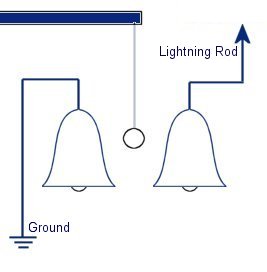
Photo Courtesy: www.mycybernetics.com
The arrangement of bells that Franklin used was actually invented by Andrew Gordon in 1742. Gordon’s bells were the first electrostatic device that converted electric energy into mechanical energy. Franklin changed the source of electric charge and replaced clappers with a metallic ball.
How Franklin Bells Work
When a thunderstorm approached, the negative charge of the clouds was attracted by the lightning rod, and then transferred to the bell connected to it. After some charge accumulated in the bell, it attracted the metallic ball. On touching, the negative charge of the bell would be transferred to the ball. Once the ball also became negatively charged, it would be repelled by the bell. When the ball swung to the other bell, the charge transferred from the ball to the bell and neutralized in the ground. The process repeated itself and the ball moved to and fro between the two bells. This continued all the while the lightning rod continues to pass electric charge to the bell.

Photo Courtesy: www.mycybernetics.com
Make Your Own Franklin Bells
You can easily make your own Franklin bells using two cold drink cans, a straw, tape and some thread. Watch this video to see how.
An interesting source of electric charge could be your TV screen if you can’t arrange for a Van der Graaff generator or other equipment.
Related Articles: